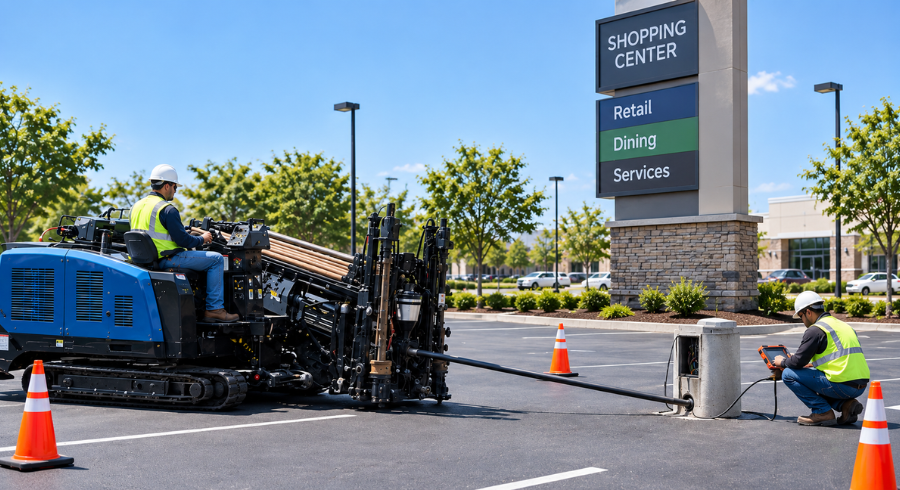
Getting power to a pylon or monument sign means running electrical conduit from your building’s panel, under the parking lot, to the sign base. The cleanest way to do it is directional boring, a no-dig method that tunnels the conduit beneath the asphalt without cutting or closing your lot.
This guide walks through how sign power is installed underground, the electrical code basics that keep it safe, and why trenchless boring saves commercial property owners time, money, and tenant complaints.
Planning a new sign or fixing a dark one? Get a free, no-obligation quote.
Why Is Sign Power So Hard to Run in a Parking Lot?
Your electrical panel usually sits inside or behind the building. Your sign stands out at the street edge, across a finished parking lot.
To connect the two, the conduit has to cross that pavement. Open-cut trenching saw-cuts a channel through the asphalt, closes rows of spaces, and leaves a patched scar behind.
For a retail plaza or a busy storefront, that adds up fast: lost parking, frustrated tenants, slow permits, and an asphalt restoration bill that often costs more than the sign hookup itself. Owners planning a wider retail center electrical upgrade can often fold the sign feed into the same underground plan.
A dark or flickering sign also costs you business every night it is out. The faster and cleaner the power is restored, the sooner the sign is working for you again.
How Does Power Get to a Pylon or Monument Sign?
The path is the same for most illuminated signs. Power leaves the panel on its own circuit, travels through underground conduit across the lot, and rises at the sign foundation.
From there it feeds a weatherproof box at the base, then runs up into the sign cabinet to power the LED modules. Here is the basic chain:
- A dedicated circuit at the building's electrical panel
- Underground conduit carrying the wire across the parking lot
- A pull box or junction box at the sign's concrete base
- Wiring up the pole into the illuminated cabinet
- A disconnect switch within sight of the sign
A pylon sign sits high on one or two poles, so the vertical run up to the cabinet is longer and the cabinet often carries more LED load. A monument sign is low to the ground, so the vertical run is short and sits close to the foundation.
Either way, the hard part is the same: crossing the parking lot underground to reach the sign.
Directional Boring: The No-Dig Way to Power Your Sign
Instead of trenching across the pavement, directional boring steers a drill head beneath the lot and pulls the conduit through a clean underground path. Here is how directional boring works from the first pilot bore to the finished conduit.
The surface stays whole from the panel to the sign. For most commercial jobs, the bore is finished in a single day. The benefits are easy to see:
- Your lot stays open to customers and tenants during the work
- No asphalt cutting and no costly surface restoration
- Fewer permits and less downtime than open trenching
- A straight, protected conduit path with room for future upgrades
Short crossings under a sidewalk or a single parking row can also be handled with pneumatic missile boring, which sets a line in minutes. For a side-by-side look at the two approaches, see directional boring versus open-cut trenching.
Want power to your sign without closing the lot? We bore it clean.
Contact Trenchless Drilling for a free estimate | Call (305) 600-1734
Electrical Code Basics That Keep Sign Power Safe
Illuminated signs follow clear rules under the National Electrical Code (NEC). Getting these right is what separates a safe, inspection-ready install from a future service call:
- Signs need a dedicated 20-amp branch circuit (NEC 600.5)
- A disconnect switch must sit within sight of the sign (NEC 600.6)
- A weatherproof pull box at the sign base for safe wire access and future maintenance
- UL-listed components, proper grounding and bonding, and correct conduit burial depth
The conduit itself matters too. We size it for the load and leave a spare path where it makes sense, using proven underground conduit installation methods so the wire is protected for decades. For Central Florida properties, we also handle pull box installation Kissimmee projects at sign bases and along the conduit path.
What Drives the Cost of Sign Power?
No two sign jobs price the same. A quick quote depends on a handful of clear factors, and a good contractor walks you through each one before any work starts:
- Bore distance from the panel to the sign across the lot
- Sign type and height, which set the vertical run and the electrical load
- Pavement type and thickness over the bore path
- Permits, inspections, and any utility coordination
- Panel capacity and whether a new circuit or upgrade is needed
Because boring skips asphalt cutting and restoration, the total cost is usually lower than open trenching once the repair bill is added in, even when the bore itself looks similar on paper.
Step-by-Step: Installing Underground Sign Power
Every sign power project follows a clear sequence. Here is how the job runs from start to finish:
- Locate existing utilities and plan the safest bore path across the lot.
- Bore under the pavement and pull the conduit through in one pass.
- Set the base pull box and stub the conduit up at the sign foundation.
- Tie the circuit into the panel and run wire up into the cabinet.
- Install the disconnect, energize the sign, and test every connection.
The underground run is the same skill behind running conduit to parking lot lights, only the end point changes from a light pole to your sign. The same method also supports EV charging station installation on commercial lots, where conduit has to cross the pavement to reach each charger.
Why Commercial Property Owners Choose Trenchless Drilling
We are a licensed Florida general contractor (CGC1526763) with more than 20 years of trenchless experience and over a million linear feet of conduit installed.
For sign power, that means your lot stays open, your tenants stay happy, and your install passes inspection the first time. No lane closures, no torn-up asphalt, no surprise restoration costs.
Run a sign company? We handle the underground electrical and the bore across the lot, so you can focus on the cabinet and the install above ground. It is a simple, reliable way to give your clients a cleaner finished job.
Frequently Asked Questions
How is power run to a pylon sign in a parking lot?
Power runs from the building’s electrical panel through underground conduit to the sign base, then up into the cabinet. Directional boring installs that conduit beneath the lot without cutting the pavement.
Can sign conduit be installed without digging up the lot?
Yes. Directional and pneumatic boring tunnel the conduit under the asphalt, so the surface stays intact and the lot stays open during the work. Only two small access points are needed, one at each end of the bore.
What size electrical circuit does a sign need?
Most illuminated signs require a dedicated 20-amp branch circuit under NEC 600.5, plus a disconnect switch within sight of the sign under NEC 600.6. Larger or multi-tenant pylon signs may need more than one circuit.
How deep is sign conduit buried under a parking lot?
Burial depth depends on the conduit type and local code, but a bored path under a lot typically runs well below the pavement base for full protection. We set the depth to meet NEC and local requirements.
Do pylon and monument signs use the same underground feed?
Yes. Both are fed by a circuit run across the lot through underground conduit. The difference is above ground: a pylon sign has a taller run up the poles, while a monument sign sits low to the base.
Final Thoughts: Power Your Sign Without Tearing Up the Lot
Pylon sign electrical installation comes down to one challenge: getting power across a finished parking lot. Open-cut trenching solves it, but it brings saw-cuts, closed parking rows, and a restoration bill. Directional boring offers another route. It places conduit beneath the pavement, so your lot stays open and the surface stays mostly intact. It does not fit every site, so a quick review of soil, depth, and existing utilities should come first.
Plan the conduit route early, confirm the circuit and code requirements with your electrician, and add a spare path for future upgrades. Those three steps prevent most sign power delays.
Ready to light up your pylon or monument sign the clean way? Trenchless Drilling runs power under your parking lot with zero surface damage and full code compliance across Florida. Get your free sign-power estimate today.