Directional boring vs trenching are the two most common methods for installing underground utilities, and choosing the wrong one for your project can cost you significantly more time, money, and surface damage than necessary. Directional boring is the better choice when surface preservation matters, while trenching works well in open, unobstructed areas where speed and simplicity take priority.
But the full answer depends on your specific site. This guide breaks down both methods side by side so you can make a confident, informed decision, whether you’re a homeowner, general contractor, or property manager planning an underground installation in West Palm Beach, Orlando, or Ocala.
What Is Directional Boring?
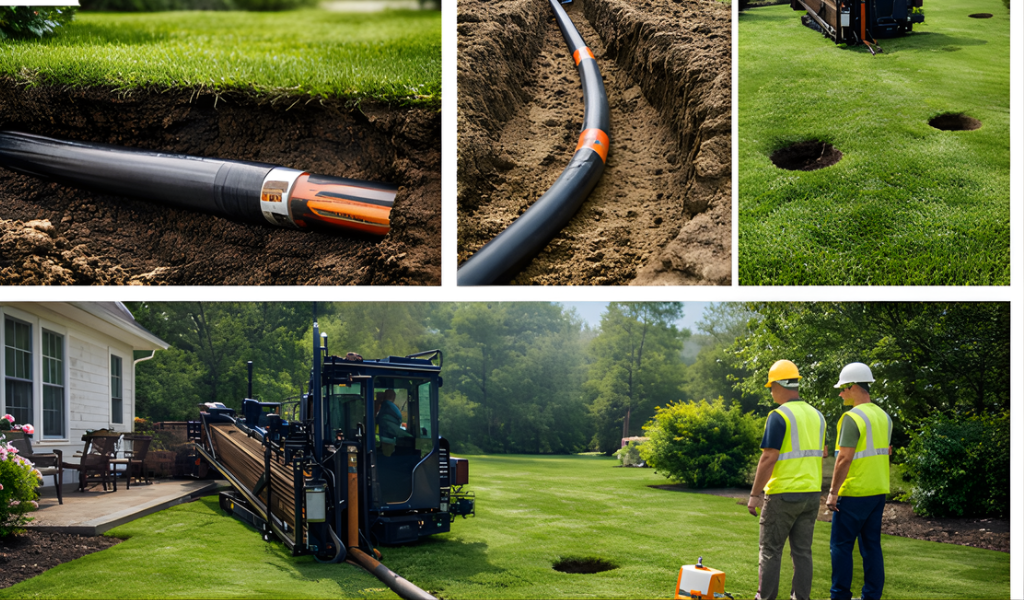
Directional boring, also called horizontal directional drilling (HDD), is a trenchless method that installs underground pipes, conduit, and cables without breaking open the surface. A surface-launched drilling rig steers a drill bit through the ground along a pre-planned underground path. Once the bore is complete, the pipe or conduit is pulled back through the hole.
The result: a clean underground installation with only two small access points at each end. No open trench. No concrete to remove. No landscaping to restore.
Directional boring is used to install:
- Electrical conduit and power lines
- Fiber optic and telecommunications cables
- Water and sewer lines
- Gas lines and service connections
- Drainage systems and stormwater infrastructure
What Is Trenching?
Trenching involves digging an open trench from one point to another, installing the utility line at the base of the trench, then backfilling and restoring the surface. It is the traditional method and is still widely used on the right type of project.
Trenching is typically performed with a trencher machine, backhoe, or excavator, depending on the depth and width required. Once the pipe or conduit is placed, the trench is backfilled, compacted, and the surface is restored.
Trenching works well when:
- The project runs through open land with no surface obstructions
- There is no existing concrete, asphalt, or finished landscaping in the path
- The utility requires direct access during installation for inspection
- Soil conditions and depth make open-cut work the most practical option
The Real Cost Comparison: Trenching Vs Directional Boring
When choosing between the two methods, the trenching cost per foot typically ranges from $5 to $30+, depending on the site and conditions. However, surface restoration, including concrete or asphalt removal, can add high costs, especially in developed areas like Orlando and Ocala, where urban infrastructure might complicate the project.
Directional boring is typically more expensive per foot ($10 to $60+). But when you factor in the costs of surface restoration, landscaping repair, and the need for traffic control or temporary road closures, trenchless drilling in Orlando often turns out to be more cost-effective. Especially in developed areas or those with existing underground utilities.
Directional Boring vs Trenching: Side-by-Side Comparison
| Factor | Directional Boring | Traditional Trenching |
|---|---|---|
|
Surface disruption
|
Minimal, two small access points only |
High, full open trench across the run |
|
Concrete/asphalt removal
|
Not Required |
Often required and expensive to restore |
|
Landscaping impact |
None |
Significant, grass, trees, and irrigation affected |
|
Traffic Disruption
|
None or very limited |
Can be significant on developed properties |
|
Precision |
High, electronic tracking throughout |
Moderate, operator-guided depth and alignment |
|
Best for |
Roads, driveways, and developed properties |
Open land, rural areas, and new construction sites |
|
Surface restoration required |
No |
Yes, often a major cost factor |
|
Safety around existing utilities
|
High, bore path steered precisely |
Moderate, open trench exposes more infrastructure |
|
Typical cost per foot |
$10 – $60+ |
$5 – $30+ (but restoration adds to total) |
When Directional Boring Is the Better Choice
Directional boring is typically the smarter method whenever surface preservation is a priority or when the installation path crosses existing infrastructure. Specifically, HDD is the better choice when:
You’re crossing a road, driveway, or parking lot. Cutting through asphalt or concrete for trenching requires removal and restoration, both costly and disruptive. Directional boring passes underneath with no surface impact.
Landscaping, irrigation, or mature trees are in the path. Open trenching tears up everything in its path. Boring avoids it entirely.
You’re working near existing underground utilities. HDD drill paths can be steered precisely to avoid gas lines, water mains, fiber optic cables, and other buried infrastructure. A properly planned bore with utility locating and ground penetrating radar reduces the risk of striking existing lines.
The project is in an urban or developed area. Congested utility corridors in cities and suburbs leave little room for open-cut work without disrupting services or neighboring properties.
If you’re looking for a trenching contractor in West Palm Beach for an open-field run, trenching may be the right approach. But for any developed or constrained site, trenchless drilling is almost always the better call.
When Trenching Is the Better Choice
Trenching still has a legitimate place in underground utility work. It makes the most sense when:
- The installation runs across open, unobstructed land with soft soil
- There is no concrete, asphalt, finished landscaping, or active utilities in the path
- The project is in a rural or greenfield area where surface restoration is minimal
- Local regulations require a sand bed beneath the utility (such as some gas line installations)
- The budget is constrained, and the site conditions genuinely make trenching the lower-cost option
In many large-scale new construction sites and rural utility runs, traditional trenching is efficient, cost-effective, and completely appropriate. A reputable contractor will assess your specific site and recommend the right method, not the one that’s easiest for them.
Frequently Asked Questions: Directional Boring vs Trenching
Is directional boring always more expensive than trenching?
Not when you account for total project cost. Directional boring has a higher per-foot rate, but avoids concrete removal, surface restoration, landscaping repair, and traffic control costs that trenching often requires on developed properties. On open land with no obstructions, trenching is usually the lower-cost option.
Which method is safer for existing underground utilities?
Directional boring is generally safer near existing utilities. The drill path is tracked electronically in real time and can be steered around known obstructions. Combined with proper utility locating and GPR scanning, HDD significantly reduces the risk of striking buried infrastructure.
Can directional boring be used for sewer lines?
Yes. Directional boring is regularly used for new sewer line installations and trenchless sewer line replacements. It is particularly effective in developed areas where open trenching would require extensive surface restoration.
What’s the difference between directional boring and trenchless technology?
Directional boring is one method within the broader category of trenchless technology, which also includes methods like pipe bursting, pipe lining, and missile boring. All trenchless methods share the goal of installing or rehabilitating underground utilities with minimal surface disruption.
Which method is better for a residential driveway crossing?
Directional boring is almost always the right choice for driveway crossings. Trenching would require cutting through concrete or asphalt, then restoring it, adding high cost and time. A short directional bore passes cleanly underneath in a fraction of the time with no surface damage.
Conclusion
Directional boring and trenching are two key methods for underground utility installation, each with distinct advantages. Directional boring is ideal for surface preservation, urban areas, and sites with existing infrastructure, while trenching is more suitable for open, unobstructed areas. Choosing the right method depends on project conditions, budget, and the need for surface restoration.
Get a Free Estimate From Trenchless Drilling, LLC
Not sure which method is right for your project? Trenchless Drilling, LLC is a licensed (CGC1526763), insured, and BBB-accredited underground utility contractor serving West Palm Beach, Orlando, Ocala, and surrounding Southeast Florida communities. With 20+ years of experience, we help residential and commercial clients choose the right method and execute it properly, every time. Whether you are looking for directional boring, trenching, or trenchless excavation in Ocala, West Palm Beach, and Orlando, contact us!