The best way to install pipe under driveway or sidewalk surfaces without breaking them open usually comes down to three main options: horizontal directional drilling (HDD), pneumatic missile boring, and auger boring. Each method creates an underground path through small access pits, allowing concrete, asphalt, and landscaping above to remain untouched. Each one creates the path underground through small access pits, so the concrete or asphalt above stays untouched.
If you’re comparing quotes or just trying to understand what a trenchless contractor is proposing for your property, knowing the difference between these four methods makes the decision a lot easier. This guide explains how each one works, when it fits, and how they stack up against each other for a typical residential or commercial crossing.
Why Does the Method Matter When You Install Pipe Under a Driveway?
For projects involving trenchless drilling in West Palm Beach, choosing the right boring method is important for protecting driveways, sidewalks, and surrounding property. Not every crossing is the same, and the method a contractor chooses affects cost, timeline, and how much disruption you’ll see on the surface. Distance, pipe size, soil conditions, and whether it’s new construction or a replacement all factor into which method fits best.
Here’s what typically drives the decision:
- The length of the crossing, since shorter runs and longer runs favor different tools
- Whether the project is a new installation or a replacement of an existing pipe
- Soil type, since sandy Florida soil behaves differently than clay or rocky ground
- Pipe diameter and material, which affects how much force or steering is needed
Method 1: Horizontal Directional Drilling (HDD)
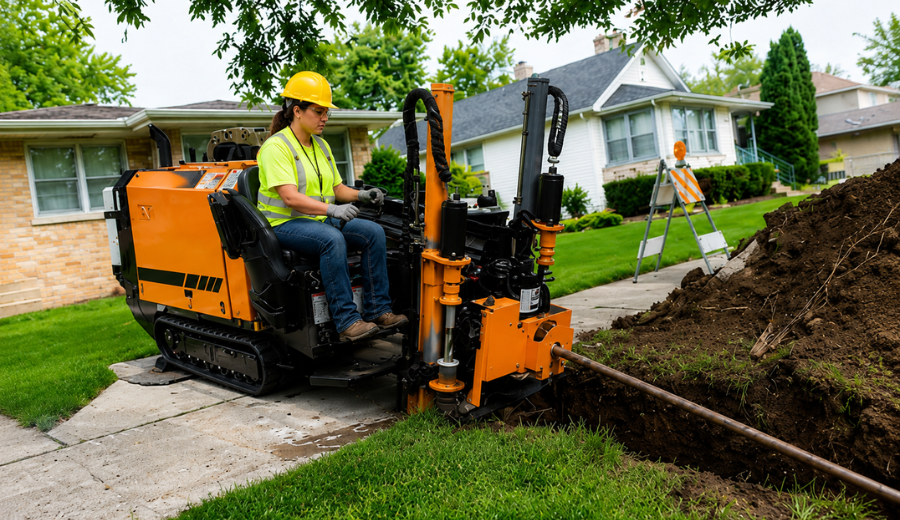
HDD is the most versatile of the four methods and the one most commonly used when contractors install pipe under driveway or sidewalk crossings that are longer or more complex. A steerable drill head creates a pilot path underground, which is then enlarged before the new pipe is pulled through.
- Best suited for longer runs or paths that need to steer around existing utilities
- Uses a drill rig at the entry point and a small exit pit on the other side
- Handles a wide range of pipe types, including water, sewer, gas, and conduit
- Delivers precise depth and alignment control, even on curved or obstacle-heavy paths
Method 2: Pneumatic Missile Boring
Missile boring uses a compressed-air tool to punch a straight tunnel underground, making it one of the fastest options for short, direct crossings. It requires less equipment than HDD, which often makes it a more economical choice for smaller jobs.
- Ideal for straight runs generally under 100 feet, like a single driveway or sidewalk crossing
- Requires only two small access pits, one on each end of the bore path
- Well suited to residential projects such as irrigation sleeves or EV charger conduit
- Completes many residential bores in under a few hours from start to finish
Method 3: Auger Boring
Auger boring uses a rotating cutting head to remove soil while a casing pipe is pushed forward behind it, creating a straight and stable path underground. It’s often chosen for larger-diameter pipe or when a protective casing is required around the utility line.
- Works well for larger pipe sizes that need a steel casing for structural support
- Provides strong alignment and stability during longer, straight-line crossings
- Commonly used beneath driveways, sidewalks, and occasionally light commercial crossings
- Suited to situations where soil conditions require extra support around the new pipe
How Do These Three Methods Compare Side-by-Side?
Choosing between HDD, missile boring, and auger boring usually comes down to matching the method to your specific project rather than picking a favorite. Here’s a quick side-by-side to make that comparison easier.
- HDD: Best for longer or curved paths, most versatile pipe types, moderate to full-day timelines
- Missile Boring: Best for short, straight crossings; fastest turnaround; lower equipment cost
- Auger boring: Best for larger pipe needing a protective casing, strong stability on straight runs
What Should You Ask a Contractor Before Choosing a Method?
Before any pipe goes in the ground, it’s worth confirming that the contractor has actually evaluated your site rather than defaulting to whichever tool is already on the truck. A few direct questions can clarify whether the recommended method truly fits your project.
- Has utility locating been completed through 811 and confirmed on-site before any bore begins?
- Is this method the best fit for the length and depth of my specific crossing?
- What's the expected timeline for boring, pipe installation, and site restoration?
- Will the driveway or sidewalk surface remain completely intact throughout the process?
Why Choose Trenchless Boring Over Traditional Trenching?
Regardless of which trenchless method fits your project, all of them share the same core advantage over open-cut trenching: the surface above stays intact. Traditional trenching means cutting concrete, removing landscaping, and paying for days of restoration afterwards. Whether you need to install pipe under a driveway or bore under sidewalk sections closer to the street, trenchless methods get the job done without tearing up what’s already there.
- Preserves driveways, sidewalks, and landscaping without cutting or patching
- Reduces total project cost by eliminating demolition and resurfacing
- Shortens timelines significantly compared to trenching and repaving
- Keeps utility strikes to a minimum with proper locating before any boring begins
Where We Provide Trenchless Pipe Installation Services
Trenchless Drilling, LLC offers these trenchless installation methods across Florida, matching the right tool to each property’s specific crossing instead of applying a one-size-fits-all approach. Our crews evaluate soil conditions, pipe size, and distance before recommending HDD, missile boring, or auger boring for a project.
We provide trenchless drilling, missile boring, and trenchless boring in Ocala, along with the same services across Tampa, Jacksonville, and Gainesville. Whether your project involves plans to run a water line under a driveway or a different kind of crossing entirely, our team locates, bores, and restores the site in a single coordinated visit.
Frequently Asked Questions
What is the best method to install pipe under a driveway?
It depends on the crossing length and pipe type, but HDD and missile boring are the two most common methods for driveway installations.
Can these methods be used to bore under a sidewalk too?
Yes. HDD, auger boring, and missile boring in Orlando are all commonly used for sidewalk crossings, typically with missile boring favored for shorter, straighter paths.
How do I know if I need auger boring instead of HDD?
Auger boring is typically recommended when the pipe is larger in diameter or requires a protective casing for structural support.
How long does it take to run a water line under a driveway using these methods?
Most residential projects are completed within a few hours to a single day, depending on the method and length of the crossing.
Do all trenchless boring methods require utility locating first?
Yes. Every method requires locating existing utilities through 811 and on-site equipment before boring begins, regardless of which tool is used.
Final Thoughts
Installing pipe under a driveway or sidewalk doesn’t require a one-size-fits-all approach. Whether the project calls for HDD, missile boring, or auger boring, matching the method to your specific crossing is what keeps the surface intact and the project on budget.
If you have a driveway or sidewalk crossing project in West Palm Beach, Orlando, Ocala, or anywhere else in Florida, Trenchless Drilling can evaluate your site and recommend the right method. Request a free estimate or call (305) 600-1734 to get started.
Get the Right Trenchless Solution for Your Pipe Installation
Need to install a pipe under a driveway or sidewalk without damaging the surface? Trenchless Drilling, LLC, can assess your project, recommend the right boring method, and complete the installation with minimal disruption. Contact our team today for a free estimate and a reliable solution built around your property’s needs.