
Installing new parking lot light poles sounds straightforward, until you look at what has to happen underground.
You need a safe electrical route from the power source to each pole. That may mean running conduit across an existing parking lot, around landscaping, beneath drive lanes, or through areas that can’t simply be dug up and repaired.
So, can you install parking lot lighting without cutting long trenches through the asphalt?
Often, yes. When site conditions and the project design are suitable, directional boring can place underground electrical conduit beneath existing pavement while greatly reducing surface disruption.
Here’s what commercial property owners, contractors, and facility managers should know before starting a parking lot lighting project.
What Is Involved in Parking Lot Light Pole Installation?
A parking lot light repair is only one part of the project.
A complete installation may involve:
- Site and utility assessment
- Lighting layout and pole placement
- Pole and fixture selection
- Concrete foundations or bases
- Underground electrical conduit
- Wiring and electrical connections
- Trenching or directional boring
- Permits and inspections
- Testing and final commissioning
The underground portion deserves particular attention.
If your parking lot is already paved and operating, cutting trenches through the asphalt can create traffic problems, require pavement restoration, and interfere with customers, employees, tenants, or deliveries.
That is why the conduit route should be considered before the poles are installed, not as an afterthought.
How Do You Plan a Parking Lot Lighting Project?
Think of the project as a route-planning exercise.
First, determine where the poles need to go and how the lighting should cover the property. Pole height, fixture type, spacing, mounting location, and the required light levels all affect the final layout.
Next, work backward from the poles to the electrical source.
Where will the conduit run?
Will it cross an active parking area? A driveway? Landscaping? A sidewalk? A roadway?
Existing underground utilities also need to be identified before drilling or excavation begins.
Don't Forget the Underground Route
A lighting plan may look perfect on paper but become much more complicated when you account for existing utilities and pavement.
That’s where an experienced underground contractor can help determine whether conventional trenching or directional boring is more appropriate for the site.
Can You Install Parking Lot Lighting Without Cutting the Asphalt?
Yes, in many situations, but not every site is a candidate for trenchless installation.
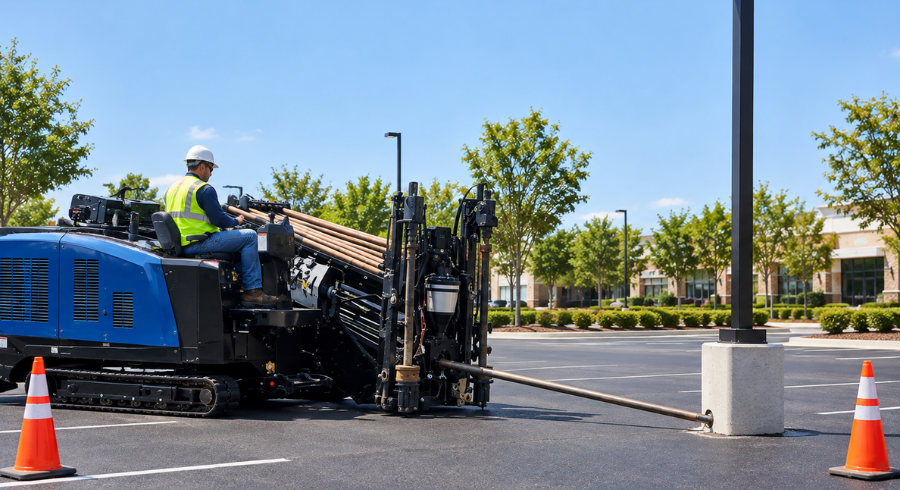
With horizontal directional drilling, a small entry point is used to guide a drill underground along a planned path. The bore can then be enlarged as needed, allowing conduit to be pulled into place.
Instead of creating a continuous open trench across the parking lot, the conduit travels underground between planned access points.
The result can be significantly less disruption to the pavement and surrounding property.
However, directional boring isn’t a magic solution. Soil conditions, rock, existing utilities, bore length, depth, conduit size, access, and the required path all matter.
A proper site evaluation should come before deciding which installation method to use.
Directional Boring vs. Traditional Trenching
| Installation method | Surface disruption | Best fit |
|---|---|---|
|
Traditional trenching
|
Higher |
Open soil or new construction |
|
Saw-cut/trenching
|
Moderate to high
|
Short accessible runs
|
|
Directional boring |
Lower when suitable
|
Existing pavement, driveways, roads, and landscaped areas
|
The cheapest installation method on paper isn’t necessarily the lowest-cost project overall.
If trenching means removing asphalt, hauling material away, restoring the pavement, managing traffic, and delaying business operations, those additional costs need to be considered.
What Does the Installation Process Look Like?
While every project is different, commercial parking lot light pole installation typically follows these steps:
1. Assess the property
Review the site, proposed pole locations, access points, existing utilities, soil conditions, and the intended conduit route.
2. Plan the lighting and electrical layout
Determine pole locations and identify how the electrical system will connect each location.
3. Choose the underground installation method
For an open area, conventional excavation may make sense.
For an existing parking lot, directional boring may be considered when the site conditions and design allow it.
4. Install the conduit
The contractor installs the underground electrical pathway using the selected method.
For trenchless projects, the bore is guided beneath the surface, and the conduit is pulled into the completed bore.
5. Complete the foundations and poles
Once the underground infrastructure is ready, pole foundations, poles, fixtures, and electrical connections can be completed according to the project design.
6. Test and inspect
The completed system should be tested and inspected as required before the lighting is placed into service.
Real Project Example: Conduit Under an Active Parking Lot
Here’s why the underground portion matters.
Trenchless Drilling’s published project portfolio includes a Miramar, Florida, commercial project involving 320 linear feet of electrical conduit beneath an active parking lot. The project used multiple conduits and was completed without surface disruption to the parking lot.
Another Miramar project involved 410 linear feet of two 6-inch conduits beneath an active parking lot, with steel casing used at a roadway crossing.
These projects illustrate an important point: the challenge isn’t simply installing a light pole. It’s finding a practical way to move electrical infrastructure across a functioning property.
What Affects Parking Lot Light Pole Installation Cost?
There isn’t one reliable price per pole because every commercial site is different.
Your project cost can depend on:
- Number of poles
- Pole height and material
- Fixture type
- Foundation requirements
- Electrical equipment
- Conduit size and quantity
- Total conduit length
- Soil and rock conditions
- Existing underground utilities
- Trenching versus directional boring
- Pavement restoration
- Permits and inspections
- Site access and traffic requirements
When comparing quotes, don’t look only at the installation price.
Ask what is included in the underground work, restoration, foundations, electrical connections, permits, cleanup, and testing.
A lower initial quote can become much more expensive if significant pavement restoration is added later.
Common Problems to Avoid
Planning pole locations without considering conduit
A good lighting layout still needs a practical underground route.
Ignoring existing utilities
Underground utility conflicts can create safety risks, delays, and costly changes.
Treating pavement restoration as an afterthought
If you’re cutting an existing parking lot, understand who is responsible for repairing the surface and what that restoration includes.
Choosing a drilling method before evaluating the site
Directional boring is highly useful, but it isn’t appropriate for every project. Soil, utilities, access, depth, and bore geometry all need to be evaluated.
Focusing only on the poles
The visible pole gets most of the attention. The underground infrastructure often determines how smoothly the project actually goes.
What About Parking Lot Light Repair?
If an existing lighting system is failing, replacement isn’t always the only consideration.
A contractor may need to determine whether the issue involves the fixture, wiring, underground conduit, electrical connection, or another component.
For a larger lighting upgrade or new installation, it can make sense to evaluate the entire underground route at the same time rather than repeatedly disturbing the parking lot for individual repairs.
When Should You Consider Directional Boring?
Directional boring is worth evaluating when your conduit route crosses:
- Existing asphalt
- Concrete
- Driveways
- Active parking areas
- Sidewalks
- Landscaped areas
- Roads or access lanes
- Areas where excavation would interfere with normal operations
For example, if you’re planning horizontal directional drilling in Kissimmee or another Florida commercial project, the right installation method should be determined from the actual site conditions, not simply from the project location.
Likewise, projects involving underground electrical conduit installation in Tampa may benefit from a site-specific evaluation when existing pavement or active commercial areas make open excavation difficult.
FAQs About Parking Lot Light Pole Installation
How far apart should parking lot light poles be?
There is no universal spacing that works for every property. Pole height, fixture distribution, mounting height, site geometry, required illumination, and the lighting design all affect spacing.
Can light pole conduit be installed under an existing parking lot?
Yes, when site conditions and the project design are suitable. Directional boring can provide an underground route beneath existing pavement without creating a continuous open trench.
Is directional boring always cheaper than trenching?
No. Cost depends on bore length, soil conditions, conduit requirements, access, restoration, and other project factors. The right comparison considers the total project cost, not just the excavation method.
Do I need permits for parking lot lighting?
Permit and inspection requirements vary by jurisdiction and project scope. Your electrical and construction team should confirm the requirements that apply to your property.
What should I ask a parking lot lighting contractor?
Ask who handles the lighting design, electrical work, underground conduit, permits, foundations, inspections, pavement restoration, and final testing. Also ask whether directional boring is appropriate for your site.
Planning a Parking Lot Lighting Project?
Installing new light poles doesn’t have to mean cutting long trenches through an existing commercial parking lot.
If your project requires parking lot lighting conduit beneath pavement, landscaping, driveways, or active commercial areas, Trenchless Drilling, LLC, can evaluate the underground portion of the project and determine whether directional boring is a suitable approach.
With more than 20 years of experience and hundreds of completed projects, our team works with property owners, contractors, and commercial teams on underground conduit and trenchless installation projects across Florida.
Ready to plan the underground portion of your project? Request a free estimate from Trenchless Drilling and tell us where the conduit needs to go.