
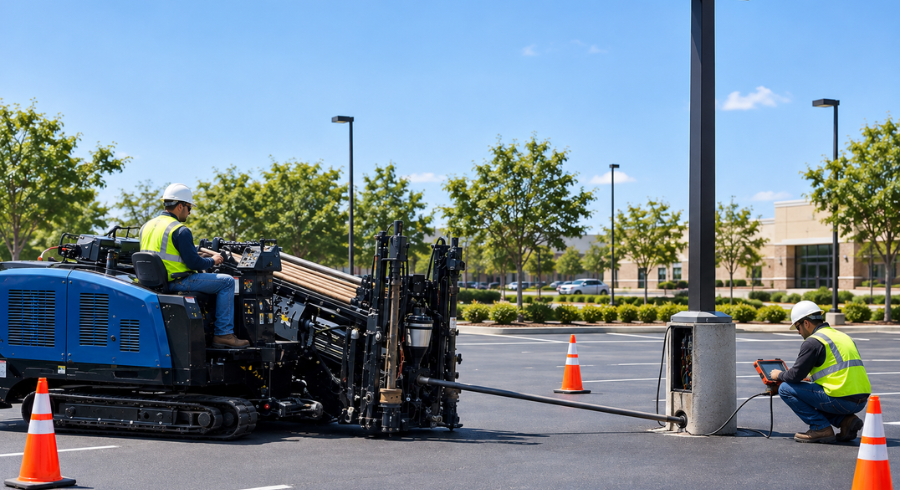
When several parking lot lights stop working at once, the problem may be more than a failed bulb or LED fixture. A tripped breaker, flickering lights, or an entire row of dark fixtures can point to an electrical fault below the pavement.
For commercial property owners and facility managers, underground lighting problems create an additional concern: how do you access the damaged infrastructure without tearing up the parking lot?
Traditional excavation can disturb asphalt, concrete, landscaping, and active parking areas. But depending on the cause of the failure, there may be a less disruptive approach.
With proper electrical troubleshooting, utility locating, and trenchless construction, contractors can identify underground problems and determine whether the existing infrastructure can be repaired or whether new conduit should be installed.
Can Parking Lot Lighting Be Repaired Without Digging?
Sometimes.
The first step is identifying whether the problem is with the fixture, electrical connection, wiring, or underground conduit. A qualified electrician should handle electrical testing and repairs to electrical conductors and components.
If damaged conduit needs replacement, trenchless methods such as horizontal directional drilling (HDD) or boring may allow new conduit to be installed beneath the parking lot without creating a continuous open trench.
Trenchless work may still require entry and exit points, but it can greatly reduce disruption to finished surfaces.
What Causes Parking Lot Lights to Fail?
Commercial parking lot lighting systems can develop problems for several reasons, including:
- Failed LED fixtures, lamps, or drivers
- Damaged underground wiring
- Water intrusion
- Loose or corroded connections
- Damaged conduit
- Faulty breakers or lighting controls
- Underground utility damage
- Construction or paving activity
- Aging electrical infrastructure
The pattern of the failure can provide an important clue.
If one light stops working, the issue may be limited to that fixture or its connection. If several lights along the same section fail together, the problem may involve a shared circuit, feeder, junction point, or underground wiring.
That is why it is better to diagnose the problem before excavating.
How Do You Know if the Problem Is Underground?
Several symptoms can indicate that a parking lot lighting problem may involve underground infrastructure.
| Symptom | Possible Cause |
|---|---|
|
One light is out
|
Fixture or local connection
|
|
Multiple lights are out |
Circuit or underground wiring
|
|
Lights flicker |
Loose connection, moisture, or damaged wiring |
|
Breaker repeatedly trips |
Electrical fault or short circuit |
|
Failure follows paving or construction |
Buried infrastructure may be damaged |
|
Existing conduit is damaged |
Conduit replacement may be needed |
A professional investigation can help determine whether the problem requires electrical repair, underground construction, or both.
Locate Before You Excavate
Commercial properties often have multiple buried systems, including electrical, telecommunications, irrigation, water, and other utilities.
Private utility locating can help identify underground infrastructure that may not be included in public utility markings. Ground-penetrating radar (GPR) may also be used to investigate subsurface conditions and locate certain buried features.
GPR does have limitations. Soil conditions, moisture, target size, and depth can affect detection. Federal Highway Administration guidance recommends using GPR as part of a broader utility-locating process rather than relying on one method alone.
For Central Florida properties, GPR scanning services in Kissimmee may be useful when additional information about buried infrastructure is neede
Why Underground Wiring Makes Light Repair Complicated
Parking lot lighting infrastructure can run beneath parking spaces, drive aisles, sidewalks, landscaped areas, and road crossings.
A typical system may include underground electrical conductors, parking lot lighting conduit, junction boxes, hand holes, pull boxes, lighting poles, fixtures, and controls.
The location of the failed fixture does not necessarily identify the location of the underground fault. A damaged section of conduit or wiring could be farther along the circuit.
Digging directly beneath a failed light without understanding the system can therefore create unnecessary excavation and restoration work.
How Professionals Find an Underground Lighting Fault
A commercial parking lot light repair investigation may include:
- Identifying the affected fixtures and circuits.
- Reviewing the existing lighting layout.
- Performing appropriate electrical testing.
- Locating public and private underground utilities.
- Using GPR or other investigation methods when appropriate.
- Identifying conduit routes and potential conflicts.
- Determining whether repair or replacement is appropriate.
This process is particularly important on older commercial properties where underground systems may have been expanded or modified over time.
Can New Conduit Be Installed Without Digging Up the Parking Lot?
In many cases, yes.
If existing conduit is damaged, inaccessible, or unsuitable for continued use, replacing the underground pathway may be more practical than repeatedly repairing the same system.
HDD and other trenchless boring methods can create a controlled underground route beneath paved areas while avoiding a continuous trench.
This can be useful beneath:
- Asphalt parking lots
- Concrete areas
- Drive aisles
- Active parking spaces
- Retail entrances
- Landscaped areas
- Roadways
For commercial properties considering trenchless boring in Winter Park, a site assessment can determine whether directional drilling or another trenchless method is suitable.
The feasibility depends on factors such as soil conditions, bore length, required depth, access, existing utilities, and the project’s design.
What Is the Parking Lot Light Repair Process?
While each project is different, the work generally follows these steps:
- Diagnose the failure
Determine which lights or circuits are affected. - Check the electrical system
A qualified electrician identifies whether the issue involves the fixture, wiring, connection, controls, or underground infrastructure. - Locate underground utilities
Existing utilities and potential conflicts are identified before construction. - Evaluate the conduit
Determine whether the existing pathway can be reused or needs replacement. - Choose the construction method
If new conduit is necessary, compare conventional excavation with trenchless installation. - Install and test
The new infrastructure is installed, followed by the required electrical work and testing.
It is important to understand that trenchless drilling does not repair an electrical conductor itself. It provides an underground pathway for conduit installation or replacement when that construction work is required.
Parking Lot Lighting Conduit: Repair or Replace?
Not every lighting problem requires conduit replacement.
| Condition | Potential Solution |
|---|---|
|
Failed fixture |
Replace fixture
|
|
Faulty accessible connection |
Electrical repair |
|
Damaged conductor with usable conduit
|
Qualified electrical repair |
|
Damaged conduit |
Replace conduit |
|
Poor existing route |
Install a new pathway |
|
Extensive pavement above route |
Evaluate trenchless installation |
The goal is to restore reliable lighting while avoiding unnecessary construction.
Should You Consider an LED Parking Lot Lighting Retrofit?
An LED parking lot lighting retrofit may involve replacing fixtures, but the supporting infrastructure should also be considered. Existing wiring, conduit, poles, controls, and electrical capacity can all affect the success of an upgrade.
If the underground infrastructure is deteriorating, replacing fixtures without addressing the underlying problem may simply postpone another failure.
A lighting upgrade should therefore consider both the fixtures and the infrastructure supporting them.
How Much Does Parking Lot Light Repair Cost?
There is no standard price for underground parking lot light repair.
Costs can vary depending on:
- Number of affected fixtures
- Type of lighting system
- Location of the fault
- Condition of wiring and conduit
- Length and depth of the underground route
- Existing utility conflicts
- Soil conditions
- Required access points
- Trenchless feasibility
- Surface restoration
A site-specific assessment provides a more useful estimate than a generic price range.
For aging systems with repeated failures, replacing deteriorated infrastructure may also be more practical than paying for recurring repairs
Real-World Example: Conduit Beneath a Parking Lot
Trenchless construction can be valuable when underground electrical infrastructure must cross an active parking area.
Trenchless Drilling’s completed-project portfolio includes a Miramar project involving 410 linear feet of FPL conduit beneath an active parking lot, including two 6-inch conduits and a steel casing at a roadway crossing.
The company also documents approximately 110 feet of HDD conduit installation beneath a Walmart parking lot in West Miami for lighting power.
These projects illustrate how trenchless methods can help maintain existing paved surfaces while installing underground conduit.
Parking Lot Light Repair for Commercial Properties
Lighting failures can affect more than the appearance of a property.
For shopping centers, office parks, industrial facilities, multifamily properties, healthcare facilities, and other commercial sites, reliable exterior lighting supports nighttime operations and keeps parking areas functional.
Repairs also have to be coordinated around customers, employees, tenants, deliveries, and daily property activity.
Minimizing unnecessary excavation can help reduce both physical disruption and operational interruptions.
How to Prevent Repeat Lighting Failures
Preventive maintenance should focus on the entire lighting system, not just individual fixtures.
Property teams should:
- Investigate repeated lighting failures
- Address recurring breaker trips
- Check accessible connections
- Maintain underground utility records
- Inspect accessible conduit and pull points
- Evaluate aging infrastructure before major paving
- Coordinate electrical and civil work during renovations
If the same circuit repeatedly develops problems, investigate the underlying infrastructure instead of continually replacing fixtures.
FAQs About Parking Lot Light Repair
Can underground parking lot lighting be repaired without digging?
Sometimes. Accessible electrical problems may be repaired without excavation. If damaged conduit needs replacement, trenchless installation may reduce the amount of surface excavation.
How do you find a broken underground lighting wire?
Professionals may use electrical testing, utility locating, GPR, and other investigation methods to narrow down the location of an underground fault.
Can conduit be installed beneath an existing parking lot?
Yes. Where site conditions permit, HDD and other trenchless methods can install conduit beneath paved surfaces without creating a continuous open trench.
Is trenchless boring completely excavation-free?
No. Entry and exit areas may still require limited excavation. The main benefit is avoiding extensive open-cut excavation across the parking lot.
Should underground wiring be evaluated during an LED retrofit?
Yes. Reviewing wiring, conduit, controls, poles, and other supporting infrastructure can help prevent an upgrade from being built around an aging underground system.
Conclusion
A failed parking lot light does not automatically mean the pavement needs to be torn apart.
The right approach is to diagnose the electrical problem, locate underground infrastructure, evaluate the existing conduit, and select the least disruptive solution that fits the property.
When conduit replacement or a new underground pathway is required, trenchless drilling may provide an effective alternative to extensive excavation.
Fix the Problem Without Unnecessary Excavation
Trenchless Drilling, LLC provides underground conduit installation, utility locating, GPR services, directional drilling, and parking lot lighting infrastructure services for commercial projects.
Need to investigate an underground parking lot lighting problem? Request a site-specific evaluation to determine the right repair or conduit installation approach for your property.