
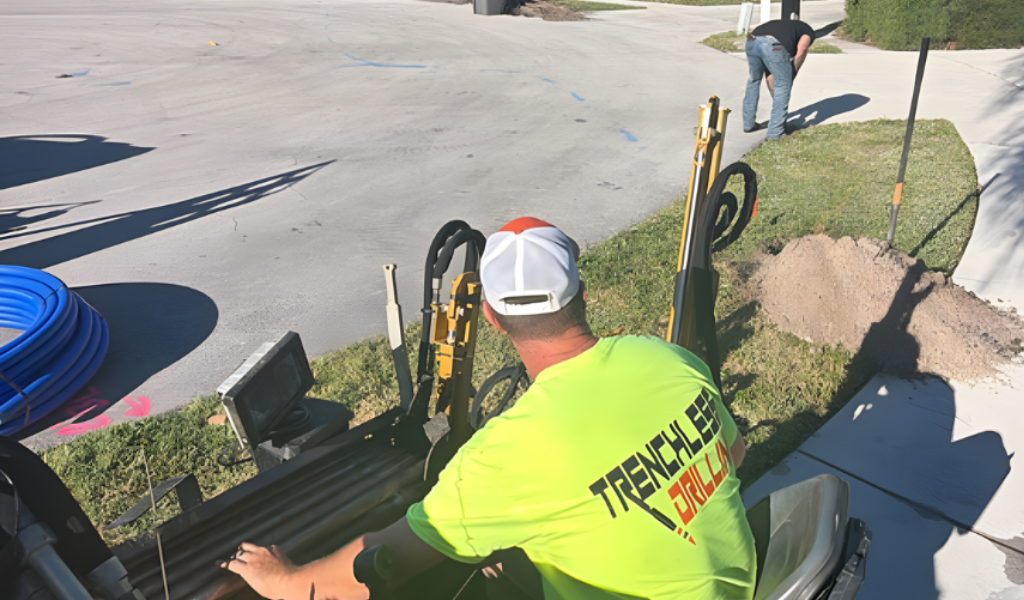
Trenchless drilling is how underground pipes, conduits, and utility lines get installed without digging open trenches across your property. Instead of ripping up your yard, driveway, or road, specialized equipment creates a precise underground path, and your surface stays completely intact.
If you’ve ever wondered how a utility line ends up beneath a paved road or manicured lawn without any visible disruption, trenchless drilling is the answer. This guide breaks down how it works, what methods are used, and when it makes sense for your project.
What Is Trenchless Drilling?
Trenchless drilling is one of the most effective forms of trenchless technology because it allows underground pipes, conduits, and utility lines to be installed without major excavation. A boring machine guides a drill bit through the soil along a controlled underground path. Once the path is created, the pipe or conduit is pulled into place.
The result is a clean, accurate underground installation, with no trenches to dig, no concrete to remove, and no landscape to restore afterward.
Trenchless drilling goes by several names depending on the method and context:
- Underground boring
- Trenchless pipe installation
- Horizontal directional drilling (HDD)
They all refer to the same core concept: installing something underground without disturbing the surface above it.
How Does Trenchless Drilling Work?
The process follows a straightforward sequence, though the specifics vary by project size and ground conditions.
Step 1 — Site Assessment and Utility Locating
Before any drilling begins, the area is evaluated. Underground utilities are marked and mapped using locating equipment and, where needed, ground penetrating radar. This step is non-negotiable; drilling without knowing what’s below is how expensive accidents happen.
Step 2 — Entry and Exit Points
Two small access points are created at either end of the planned underground path. These are the only areas where the ground is disturbed.
Step 3 — Pilot Bore
A horizontal directional drill sends a small drill bit through the ground along a pre-planned path. The drill head is tracked electronically throughout, allowing the operator to steer it with precision, even under roads, parking lots, and foundations.
Step 4 — Reaming (If Required) For larger pipes, the pilot bore is enlarged by pulling a reamer back through the hole. This step is repeated until the bore hole reaches the correct diameter for the pipe being installed.
Step 5 — Pipe Pullback
The pipe or conduit is attached and pulled back through the borehole in a single, smooth operation. At this point, the installation is complete.
Step 6 — Site Cleanup
The two small access points are backfilled and restored. There is no large trench to close, no concrete to patch, and no landscaping to redo.
Homeowners looking for trenchless drilling West Palm Beach services often choose this method to avoid damaging driveways, landscaping, and paved surfaces.
What Can Be Installed Using Trenchless Drilling?
Trenchless drilling works for a wide range of underground utilities, including:
- Electrical conduit — for power lines, service feeds, and underground distribution
- Telecommunications and fiber optic cables — for internet, cable, and data networks
- Water lines — both residential service lines and main replacements
- Sewer lines — new installations and trenchless sewer line replacements
- Gas lines — for natural gas and other fuel distribution
- Drainage systems — for stormwater and site drainage
Whether it’s a single residential connection or a large commercial utility corridor, trenchless drilling can handle it.
Trenchless Drilling vs. Traditional Trenching: What’s the Difference?
Traditional trenching involves digging a long open trench from one point to another, installing the pipe, then backfilling and restoring the surface. It works, but it comes with real costs.
Trenchless drilling avoids all of that. Here’s how the two methods compare:
Trenchless Drilling | Traditional Trenching | |
Surface disruption | Minimal, two small access points | High, full open trench |
Landscape restoration needed | No | Yes |
Concrete/asphalt repair | Not required | Often required |
Traffic disruption | None or very limited | Significant |
Project speed | Faster overall | Slower due to restoration |
Best for | Under roads, driveways, and landscaping | Open fields, new construction |
In residential and commercial areas with limited access, trenchless drilling Ocala services are often preferred because they reduce excavation and cleanup time. When the area is open and clear, traditional trenching may still be the most cost-effective option. An experienced contractor will recommend the right method based on your specific site.
Where Is Trenchless Drilling Used?
Trenchless drilling is used across residential, commercial, and municipal projects wherever surface disruption needs to be avoided:
- Under driveways and parking lots, pipe or conduit is installed without breaking concrete
- For larger municipal and commercial projects, trenchless drilling Orlando contractors use directional drilling to install underground utilities with minimal traffic disruption.
- Under roads and highways, utility crossings with zero traffic disruption
- Beneath landscaping and lawns, no damage to grass, trees, or irrigation systems
- Under-building foundations for utility connections in tight urban environments
- Across waterways or wetlands, environmentally sensitive crossings with minimal impact
Trenchless Drilling, LLC serves homeowners, contractors, property managers, condo associations, and municipal clients across West Palm Beach, Orlando, and Ocala with professional trenchless solutions.
Frequently Asked Questions
How long does trenchless drilling take?
Most residential jobs are completed in a single day. Larger or more complex projects may take a few days depending on bore length, pipe diameter, and soil conditions.
Is trenchless drilling safe for my property?
Yes. When performed by a licensed contractor using proper utility locating equipment, trenchless drilling is one of the safest underground installation methods available. Existing utilities, foundations, and landscaping remain protected.
How accurate is the drilling path?
Modern HDD equipment uses real-time electronic tracking to guide the drill head within inches of the planned path. This level of precision is what allows drilling under roads, foundations, and other sensitive structures.
Does trenchless drilling work in all soil types?
It works in most soil conditions, including sand, clay, and mixed soils common in Florida. Hard rock situations may require specialized tooling, and a site assessment will determine the right approach before work begins.
Can trenchless drilling replace old pipes?
Yes. Trenchless methods, including pipe bursting and directional boring, can be used to replace aging underground pipes without excavating along the full length of the existing line.
Conclusion
Trenchless drilling is a faster, cleaner way to install underground pipes and utility lines without tearing up roads, driveways, or landscaping. It helps reduce surface damage, restoration costs, and project delays while still providing accurate underground installation. For many residential and commercial projects, it is often the most practical and efficient solution available.
Get a Free Estimate From Trenchless Drilling, LLC
Trenchless Drilling, LLC is a licensed (CGC1526763), insured, and BBB-accredited trenchless drilling company serving Florida’s Southeast region. With over 20 years of experience and 850+ completed projects, our team delivers clean, precise underground installations for residential and commercial clients across West Palm Beach, Orlando, and Ocala. We work 7 days a week and provide flat-rate estimates with zero hidden fees.