
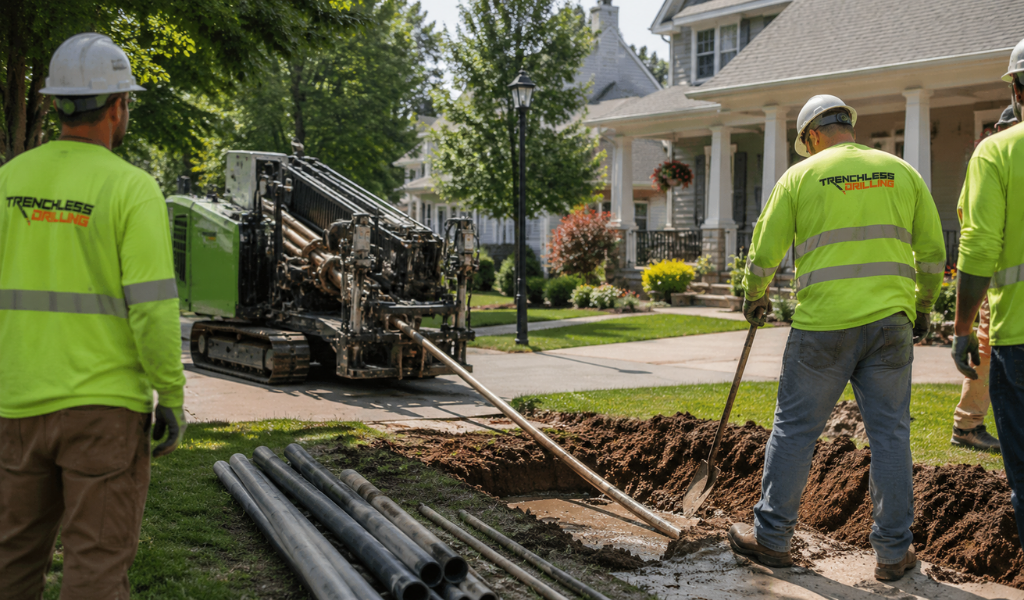
Trenchless utility installation is the modern way to run underground pipes, conduit, water lines, and cables beneath your property without tearing up your yard, driveway, or landscaping.
Traditional installation meant digging a long open trench across your property, installing the utility, then spending days or weeks restoring everything that got destroyed in the process. Trenchless methods eliminate all of that. The surface above stays untouched, the job gets done faster, and the disruption to your daily life is minimal.
If you’ve been putting off underground utility work because you didn’t want your yard torn apart, this guide explains exactly why trenchless utility installation is the smarter choice, and how it actually works.
What Is Trenchless Utility Installation?
Trenchless utility installation refers to any method of placing underground pipes, conduit, or cables without open-cut excavation along the full path of the installation.
Instead of digging a trench from point A to point B, licensed contractors use specialized equipment, inserted through one or two small access points, to create an underground path and pull the utility line through it.
Common utilities installed using trenchless methods include:
- Electrical conduit — for power lines, service feeds, and data networks
- Water lines — residential service connections and main replacements
- Sewer lines — new installations and no-dig replacements
- Gas lines — service connections and distribution lines
- Fiber optic and telecom cables — internet, cable, and communications infrastructure
- Drainage systems — stormwater and site drainage pipes
Whether it’s a single conduit under a driveway or a multi-utility run across a commercial property, trenchless installation handles it without the surface disruption that traditional excavation creates.
How Does Trenchless Utility Installation Work?
The process for underground utility installation in West Palm Beach varies slightly depending on the method and utility type, but most trenchless installations follow the same core sequence.
Step 1 — Site Assessment and Utility Locating
Before any work begins, the project area is evaluated. All existing underground utilities are located and mapped using paint marks, equipment locations, and ground-penetrating radar (GPR) where needed. This step protects your existing infrastructure and ensures the bore path is planned safely.
Step 2 — Access Point Preparation
Small entry and exit pits are created at each end of the planned installation path. These are the only points where the ground is opened up.
Step 3 — Underground Installation
Depending on the method used, the contractor either:
- Drills a precise underground path using a horizontal directional drill (HDD), then pulls the pipe or conduit through, or
- Uses a pneumatic boring tool (missile bore) for shorter, straight runs beneath driveways and sidewalks.
The method chosen depends on the distance, depth, pipe size, and what’s already underground.
Step 4 — Pipe or Conduit Pullback
The utility line is attached and pulled into place through the completed underground path in a single smooth pass.
Step 5 — Site Cleanup and Restoration
The two small access pits are backfilled and restored. No trench to close, no concrete to repave, no lawn to reseed. Most residential jobs leave the property looking exactly as it did before work started.
For more information, also read: How to run conduit under a driveway
Trenchless vs. Traditional Utility Installation: What's the Real Difference?
Let’s take a look:
| Trenchless Installation | Traditional Open-Cut | |
|---|---|---|
| Surface disruption | Minimal, two small access points | Significant, full trench across the run |
| Landscaping impact | None | Lawn, trees, and irrigation are often affected |
| Concrete/asphalt removal | Not required | Often required and costly to restore |
| Project timeline | 1–2 days for most residential jobs | Several days to weeks |
| Traffic or access disruption | Little to no | Can block driveways and walkways |
| Total cost (including restoration) | Often lower overall | Higher once surface repair is factored in |
On a developed residential property, trenchless installation is almost always the better option. The surface preservation alone saves homeowners significant time, money, and stress.
What Trenchless Methods Are Used for Utility Installation?
The right method for underground utility installation in Orlando depends on your specific project. Here’s a quick explanation of the most common trenchless approaches:
Horizontal Directional Drilling (HDD)
The most versatile trenchless method. A surface-launched drill steers a precise path underground, around existing utilities, under roads, beneath driveways, then pulls the pipe or conduit back through. Best for longer runs, larger pipes, and projects requiring precise path control.
Missile Boring (Pneumatic Boring)
A pneumatic boring tool is driven through the soil in a straight line to create a borehole for the pipe. Ideal for shorter, straight installations under driveways, sidewalks, and shallow crossings. Faster and more cost-effective for simple straight runs.
Pipe Bursting
Used specifically for replacing existing underground pipes. A bursting head fractures the old pipe outward while simultaneously pulling a new pipe into place. No trench is required along the full length of the old line.
Why Homeowners Prefer Trenchless Utility Installation
Homeowners across West Palm Beach, Orlando, and Florida consistently choose trenchless installation over traditional excavation for several clear reasons:
1. The yard stays intact. No ripped-up lawn, no damaged irrigation, no destroyed garden beds. The surface above the installation path is completely untouched.
2. Driveways and concrete don’t get cut. Cutting and replacing concrete or asphalt is expensive and takes time. Trenchless methods pass underneath, no cutting, no patching, no waiting for concrete to cure.
3. The project is done faster. Most residential trenchless installations are completed in a single day. Traditional open-cut work on the same property could take three to five days or longer once restoration is factored in.
4. The total cost is often lower. While trenchless rates per foot can appear higher, homeowners avoid the costs of concrete removal, surface restoration, landscaping repair, and extended labor. On developed properties, trenchless installation regularly comes in lower in total project cost.
5. Less disruption to daily life. No blocked driveways. No torn-up walkways. No noise and mess for days on end. The job gets done, the equipment leaves, and life continues normally.
Frequently Asked Questions
How Much Does Trenchless Utility Installation Cost?
Does Trenchless Installation Work Under Concrete Driveways?
Is Trenchless Installation Available for Residential and Commercial Projects?
Does Trenchless Installation Damage the Surface?
Conclusion
Trenchless utility installation gives homeowners and businesses a faster, cleaner, and less disruptive way to install underground utilities without damaging driveways, landscaping, or existing surfaces. Whether you need to run conduit under a driveway or complete a larger underground utility project, methods like horizontal directional drilling and missile boring provide efficient, long-lasting results with minimal excavation and restoration costs.
Get a Free Estimate From Trenchless Drilling, LLC
Trenchless Drilling, LLC is a licensed (CGC1526763), insured, and BBB-accredited trenchless utility installation contractor serving West Palm Beach, Orlando, Ocala, and Southeast Florida. With 20+ years of experience, we deliver clean, precise underground installations for residential and commercial clients, with no hidden fees and no unnecessary surface disruption.
Contact our team today to discuss your project and get a reliable no-dig installation solution.