HDPE pipe sizes are measured by outside diameter (OD), not inside diameter, and paired with an SDR rating that tells you the wall thickness and pressure capacity. Get either number wrong on a directional bore, and you’re looking at a joint that fails long before its time. If you’ve ever stood over a spec sheet wondering why a “4-inch” pipe doesn’t measure 4 inches anywhere, you’re not alone, and by the end of this piece, you’ll know exactly why.
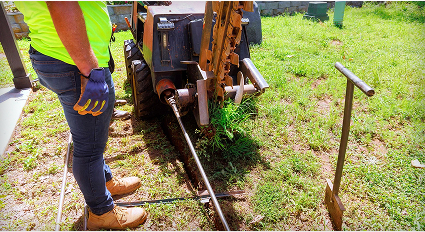
Our HDD crews in West Palm Beach rely on this exact chart on job sites every week.
Key Takeaways
- HDPE pipe size is based on outside diameter (OD), following either the IPS (Iron Pipe Size) or DIPS (Ductile Iron Pipe Size) standard.
- SDR (Standard Dimension Ratio) is OD divided by wall thickness. Lower SDR means thicker walls and higher pressure capacity.
- Pressure class (PSI rating) shifts with both SDR and the resin grade of the HDPE pipe, so two pipes with the same SDR can carry different ratings.
- Matching OD precisely between two pipe sections is critical for a clean, leak-free conduit run.
- A pipe sizing mistake rarely shows up on day one. It shows up months later, underground, where it's expensive to fix.
What Do All Those Numbers on an HDPE Pipe Actually Mean?
Every HDPE Pipe carries a print line stamped along its length. Something like “4” IPS DR 11 PE4710. It looks like alphabet soup until you break it apart piece by piece.
The size (4″) refers to the nominal diameter, not the actual OD. The “IPS” tells you which sizing system it follows. “DR 11” is the dimension ratio, and “PE4710” is the resin classification. Each piece changes how the pipe performs underground.
HDPE Pipe Sizes: IPS vs DIPS Explained
Two sizing systems dominate the HDPE world, and mixing them up is one of the most common (and costly) mistakes on a job site.
- IPS (Iron Pipe Size) matches the OD of standard steel pipe. It's the go-to system for conduit, water service lines, and most gas distribution work.
- DIPS (Ductile Iron Pipe Size) matches the OD of ductile iron pipe. You'll see it most often on municipal water main projects where the HDPE needs to tie into existing ductile iron infrastructure.
Here’s a quick look at how the two compare at common sizes:
Nominal Size | IPS OD (inches) | DIPS OD (inches) |
|---|---|---|
4″ | 4.500 | 4.800 |
6″ | 6.625 | 6,900 |
8″ | 8.625 | 9.050 |
10″ | 10.750 | 11.100 |
12″ | 12.750 | 13.200 |
Notice that at every single size, DIPS runs slightly larger than IPS. That’s exactly why a mismatch between the two systems can throw off an entire installation plan before the first bore ever starts.
SDR Ratings: The Real Story Behind Pipe Strength
SDR stands for Standard Dimension Ratio, and it’s calculated with a genuinely simple formula: outside diameter divided by wall thickness.
A pipe with an SDR of 11 has thicker walls relative to its size than a pipe with an SDR of 17. Lower SDR number, thicker wall, higher pressure rating. Think of it like tire ply ratings on a truck. Fewer plies, lighter load capacity. More plies, tougher hauling.
Common SDR ratings you’ll run into on trenchless and directional boring jobs include:
- SDR 7 – Heaviest wall, used for the highest-pressure applications.
- SDR 9 – High-pressure gas and water distribution.
- SDR 11 – The workhorse rating for most municipal water and gas conduits.
- SDR 13.5 – Moderate pressure, common in irrigation and lower-demand water lines.
- SDR 17 – Lower-pressure service and drainage applications.
- SDR 21 / 26 – Gravity flow, low-pressure, and non-pressure conduit runs.
Pressure Class Chart: Matching PSI to the Job
Pressure class ties SDR to the actual resin the pipe is made from. Modern HDPE conduit typically uses PE4710 resin, which handles higher pressures at a given SDR than older PE3408 material did.
Here’s a general reference for water-rated HDPE pipe at a 73°F operating temperature:
SDR Rating | Approx. Pressure Class (PE4710, PSI) |
|---|---|
SDR 9 | 250 PSI |
SDR 11 | 200 PSI |
SDR 13.5 | 160 PSI |
SDR 17 | 125 PSI |
SDR 21 | 100 PSI |
These numbers shift with temperature and application, so always confirm against the manufacturer’s data sheet for the specific run you’re planning. A chart is a starting point, not the final word.
Why Sizing Charts Matter for Fusion Work (Not Just Ordering Pipe)
Here’s something a lot of property owners and even some contractors don’t realize: sizing accuracy matters just as much during installation as it does during procurement.
In horizontal directional drilling, HDPE conduit is selected and joined into one continuous, seamless string before it’s ever pulled through the bore path.
Precise OD and SDR matching at this stage is what determines whether the finished run holds up under pressure for decades — or fails at a weak point a few years in.
That’s exactly the kind of detail our crews check before every job, whether we’re running HDD services in Ocala or handling conduit installation in Orlando projects across Central Florida.
OD Consistency: The Detail That Makes or Breaks a Fusion Joint
Picture two pipes with the exact same nominal size but different SDRs. One’s rated SDR 11, the other SDR 17. Their outside diameters technically match, but their wall thicknesses don’t.
Mixing those together without accounting for the difference creates an inconsistency at the joint that won’t hold uniformly. It’s a bit like welding two pieces of steel that are close in size but not quite the same thickness. The joint holds until it doesn’t.
This is why our team doesn’t just glance at a spec sheet. They measure OD and wall thickness on-site with calipers before any pipe goes into the ground, every single time.
Frequently Asked Questions
What's the difference between HDPE pipe size and its actual OD?
The nominal size printed on HDPE pipe is a label, not a measurement, while the actual outside diameter follows the IPS or DIPS standard the pipe was manufactured to.
Does a lower SDR always mean a better pipe?
Not necessarily, since a lower SDR gives you a thicker wall and higher pressure rating, but it’s only “better” if the job actually calls for that extra strength.
Can two different SDR pipes be fused together?
It’s technically possible but risky, because mismatched wall thicknesses can create an uneven fusion joint that’s more likely to fail under pressure.
Why does pressure class change even when the SDR stays the same?
Pressure class depends on the resin grade of the HDPE, so a higher-grade resin like PE4710 handles more pressure than an older resin at that same SDR.
Final Thoughts
HDPE pipe sizing isn’t just paperwork; it’s the foundation of an underground conduit run that has to hold underground for decades. Get the OD, SDR, and pressure class right, and the pipe outlasts the warranty. Get it wrong, and you’re digging up a “trenchless” job to fix it. That’s a call worth making before the trench opens.
Getting It Right the First Time
A sizing chart is useful. Knowing how to read it on a live job site, under time pressure, with mud on your boots, is a different skill entirely. That’s the gap between a DIY spec sheet and a properly installed, pressure-tested HDPE conduit run that lasts for decades.
If you’re planning a directional bore that involves HDPE pipe or HDPE pipe fittings, it’s worth having someone check the OD, SDR, and pressure class math before the trench opens. Request a free estimate, and Trenchless Drilling, LLC will walk through the sizing with you before the job starts.
(305) 600-1734
Trenchless Drilling