
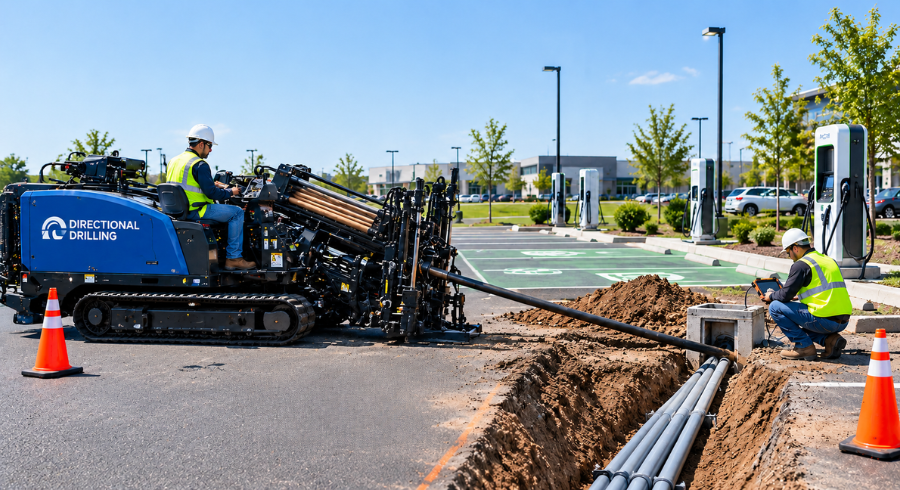
Adding EV chargers to a finished parking lot sounds simple. Pick the spots, mount the units, and plug them in. Then comes the hard part. The power has to travel from the electrical room to every charger, and most of that route is underground.
Can that route be built without ripping up the lot? Often, yes. When site conditions allow, conduit can be bored beneath pavement, so parking stays open and the surface stays intact.
This guide covers EV charging station installation from the underground side. You will learn what conduit a site needs, how to plan it, and which mistakes cost property owners the most.
What Does EV Charging Station Installation Involve?
The chargers themselves are only part of the budget. Getting power to them is often the larger expense.
In most commercial buildings, the electrical room sits on the opposite side of the property from the parking spaces. The wire has to travel that full distance underground, and the longer the run, the higher the labor and material cost.
Open-cut trenching makes it worse. Saw-cutting the lot closes parking rows, slows the job, and leaves an asphalt repair bill that can rival the charger cost itself.
Planning the route early matters too. A short, direct bore from the panel to the stalls keeps both the material and the labor down, so the conduit path is worth mapping before anything is ordered. Owners already planning a retail center electrical upgrade can map the charger conduit into the same underground plan.
How Does Power Reach EV Chargers in a Parking Lot?
The power path is the same across most commercial sites. Here is the basic chain from the panel to the plug:
- A dedicated circuit or subpanel at the building’s electrical service
- Bored underground conduit installation carrying the wire across the lot
- Conduit risers stubbed up at each charger location
- Charger pedestals mounted, wired, and connected
- Ground-fault protection and a disconnect, per code
The underground conduit is the backbone of the whole system. Get it right from the start and the chargers energize cleanly, with room to add more ports later.
Trenching vs Directional Boring for EV Conduit
Two methods move conduit across a lot. For a full breakdown, see how boring compares with open trenching, but here is the short version for EV work.
Open trenching cuts a channel straight through the asphalt. It is simple on bare dirt, but across a finished parking lot it means closed stalls, downtime, and costly resurfacing.
Directional boring, a form of horizontal directional drilling, steers a drill head under the pavement and pulls the conduit through a clean underground path. The surface stays whole and the lot stays open.
- No asphalt cutting and no restoration bill
- Customers and tenants keep parking during the work
- Most commercial runs finish in about a day
- A straight, protected path with room for future circuits
What Conduit Is Used for EV Charging Stations?
EV conduit has to survive both the ground and the parking lot above it. The right material depends on where it sits:
- Schedule 80 PVC for exposed risers and pedestals, which must resist vehicle strikes and impact
- Schedule 40 PVC or HDPE for the underground bored run across the lot
- Wet-location listed conductors, since buried conduit is treated as a wet location
One tip saves owners thousands later: install spare, capped conduit to extra parking stalls now, while the bore is already open. Adding chargers in year two then skips a second bore entirely.
Want chargers today and room to grow tomorrow? We bore for future capacity.
Level 2 vs DC Fast Chargers: What Changes Underground?
The charger type decides how much power the conduit must carry. That changes the underground design.
Level 2 chargers suit workplaces, retail, and multi-tenant lots where cars park for hours. They use standard single-phase circuits and modest conduit.
DC fast chargers turn vehicles around in minutes but pull far more power. They often need three-phase service, larger conduit, and sometimes a new transformer, which makes the bored path and panel work bigger from the start.
EV Charging Conduit and the Electrical Code
Commercial EV installs are permitted electrical projects. A few NEC rules shape the underground work:
- NEC Article 625 governs electric vehicle supply equipment (EVSE)
- Ground-fault protection is required to guard against shock
- Conduit must be sized and buried to code depth for its type
- Listed, wet-location wiring methods are required underground and outdoors
Meeting these the first time keeps the project on schedule and avoids a failed inspection and rework.
Step-by-Step: Installing EV Charger Conduit Under a Lot
A commercial charger project follows a clear order. The underground phase usually looks like this:
- Assess the panel and confirm available capacity or upgrades.
- Map the conduit route and charger layout across the lot.
- Pull permits and coordinate any utility make-ready work.
- Bore under the pavement and pull the conduit to each stall.
- Tie into the panel, run circuits, and mount the pedestals.
- Energize, add ground-fault protection, and test every port.
For short hops from a curb or island to a single charger, pneumatic boring sets the line in minutes without a full drill setup. On Florida’s Gulf Coast, directional drilling near Tampa follows these same steps from the first bore to the final test.
What Drives the Cost of a Commercial EV Install?
Pricing swings widely by scope. A few clear factors set the number:
- Number of charging ports and whether they are Level 2 or DC fast
- Conduit run distance from the panel to the parking area
- Panel capacity and whether an upgrade or transformer is needed
- Permits, inspections, and utility coordination
Industry estimates put a typical Level 2 commercial port in the several-thousand-dollar range, with DC fast chargers running much higher. Because boring skips asphalt cutting and repair, it usually lowers the total versus trenching once restoration is counted.
Make-Ready Programs and Future Expansion
Many utilities run make-ready programs that cover part of the underground work for EV charging, including conduit and panel preparation. These can offset a real share of the install cost.
Make-ready funding often rewards building for the future, not just today. Boring extra conduit and laying capped stubs to additional stalls fits these programs well and sets the site up for easy expansion.
Checking eligibility before the bore is planned lets you size the underground path once and avoid paying for a second mobilization later. Shopping centers can pair this with shopping plaza parking lot electrical work, so the underground route is planned only once.
Why Property Owners and Installers Choose Trenchless Drilling
We are a licensed Florida general contractor (CGC1526763) with more than 20 years of trenchless work and over a million linear feet of conduit installed. Our recent EV charger conduit bores include runs pulled under active commercial lots with zero surface damage.
Serving developers and contractors statewide, our crews handle trenchless construction Tampa projects and work across Florida to keep your lot open and your install on code.
Running an EV deployment at a gated or residential community instead? See our guide to EV, fiber, and lighting conduit upgrades. And if you install chargers, we handle the bore so you can focus on the equipment.
Frequently Asked Questions
How do EV chargers get power in a commercial parking lot?
Power runs from the building’s electrical panel through underground conduit to each charger pedestal. Directional boring installs that conduit under the lot without cutting the pavement.
Can EV conduit be installed without digging up the parking lot?
Yes. Directional and pneumatic boring tunnel the conduit beneath the asphalt, so the lot stays open and the surface stays intact. Only small access points are needed at each end of the bore, which keeps customer parking available throughout the job.
What conduit is used for EV charging stations?
Schedule 80 PVC is the impact-rated choice for exposed risers at the pedestal, while Schedule 40 PVC or HDPE is common for the underground run. Buried conduit uses wet-location listed conductors.
What size electrical service does commercial EV charging need?
It depends on the charger type and count. Level 2 chargers use standard circuits, while DC fast chargers often need three-phase power and sometimes a transformer. A panel assessment confirms the requirement.
How long does a commercial EV charger installation take?
Timelines vary with permits and scope, but the physical bore and conduit work across a lot is often completed in a few days once approvals are in place. Panel upgrades or utility service work can add time, so those are confirmed early.
Should I install extra conduit for future chargers?
Yes. Laying spare, capped conduit while the bore is open is far cheaper than boring again later, and it fits well with utility make-ready programs.
Final Thoughts: Plan the Underground Route First
EV charging station installation succeeds or stalls underground. The conduit route decides the schedule, the budget, and how easily you can expand later.
Directional boring keeps parking open and the surface mostly intact, though it does not fit every site. Review soil, depth, and existing utilities first.
Map the route early, confirm electrical requirements with your designer, and add spare conduit for future chargers.
Ready to power your commercial EV chargers the clean way? Trenchless Drilling bores the conduit under your parking lot with no surface damage and full code compliance across Florida.
Get your free commercial EV charging conduit estimate today.