
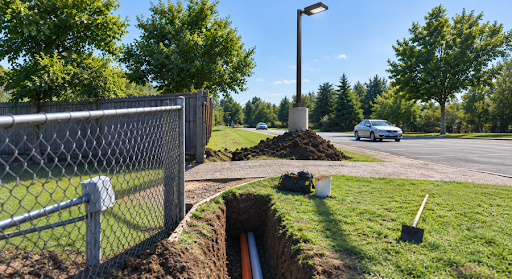
Planning an LED parking lot lighting retrofit? Don’t finalize the fixtures until you understand what’s happening underground.
For commercial property owners, facility managers, and contractors, upgrading parking-lot lighting can involve much more than replacing old metal-halide or high-pressure sodium fixtures. Existing conduit may be damaged, blocked, undersized, or routed for a lighting layout you’re no longer using.
That underground infrastructure can affect your project cost, schedule, parking-lot access, and installation method.
The takeaway: look at the electrical infrastructure before you commit to the lighting upgrade.
What Is an LED Parking Lot Lighting Retrofit?
An LED parking lot lighting retrofit upgrades an existing lighting system with LED technology instead of replacing every component from scratch.
Depending on the condition of the system, you may retrofit the existing fixture housing, replace the fixture head, or install entirely new LED fixtures. The goal isn’t simply to choose a lower-wattage light. The new system needs to provide appropriate illumination, coverage, uniformity, and reliability for the property.
For a commercial property, that means evaluating the entire parking lot lighting system, including poles, fixtures, electrical circuits, underground conduit, controls, and proposed fixture locations.
How an LED Parking Lot Lighting Retrofit Works
A typical retrofit should start with an assessment rather than a fixture purchase.
1. Inspect the existing system
Look at the current fixtures, poles, wiring, handholes, pull boxes, and conduit routes.
2. Evaluate the lighting design
Pole height, spacing, mounting position, optics, and parking-lot layout all influence light distribution.
3. Develop the LED plan
A photometric plan can help determine whether the proposed fixtures provide appropriate illumination and uniformity.
4. Plan underground work
If existing conduit cannot support the new layout, new electrical conduit or wiring may be required.
5. Install and verify
The final installation should be checked for proper operation, coverage, and electrical performance.
Contractor tip: Don’t choose your LED fixtures first and figure out the underground infrastructure later. The electrical layout can determine what fixture locations are practical.
Retrofit vs. Complete Fixture Replacement
Retrofitting may make sense when existing fixtures, poles, mounting hardware, and electrical infrastructure are in good condition.
Complete fixture replacement may be more appropriate when fixtures are obsolete or damaged, pole locations are changing, or the lighting layout needs a major redesign.
The same principle applies underground. Don’t assume existing conduit should stay simply because it’s already there. Inspect it first.
What should be checked underground?
Before an LED lighting upgrade, evaluate:
- Existing conduit routes, size, and condition
- Underground wiring and circuit capacity
- Handholes and pull boxes
- Pole bases and electrical connections
- Utility conflicts
- Existing and proposed pole locations
- Access for installation equipment
- Areas where excavation could disrupt pavement or traffic
If the existing electrical drawings or as-built plans are available, have them ready for the site assessment. They can help compare the documented layout with actual field conditions.
Need to inspect or upgrade the underground infrastructure?
If your lighting project requires new conduit, additional electrical runs, or changes to existing underground routes, Trenchless Drilling, LLC, can help with the underground portion of the project.
Why Photometric Planning Matters
Choosing an LED by wattage alone is a common mistake.
A 150-watt LED isn’t automatically the correct replacement for a 400-watt metal-halide fixture. The right solution depends on the property’s pole height, spacing, fixture optics, mounting position, required illumination, and desired uniformity.
Two parking lots can use the same LED fixture and still produce very different results.
A photometric plan shows how light is expected to distribute across the site. It can help identify dark areas, excessive brightness, glare, and other problems before installation.
For a commercial parking-lot lighting upgrade, that’s far more useful than comparing wattage numbers alone.
When Does an LED Retrofit Require New Underground Wiring?
New underground infrastructure may be necessary when:
- Existing conduit is damaged or blocked.
- Underground wiring needs replacement.
- New lighting poles are being added.
- Pole locations are changing.
- New circuits are required.
- The lighting layout is being redesigned.
- Existing conduit routes don't match the proposed system.
The key question isn’t simply, “Can we install LED fixtures?”
It’s “Can the existing electrical infrastructure support the new lighting design?”
Can Conduit Be Installed Beneath an Existing Parking Lot?
Yes. Horizontal directional drilling (HDD) can install underground conduit beneath paved areas while minimizing surface excavation when site conditions are suitable.
This can be useful when cutting through an existing parking lot would create unnecessary disruption, traffic problems, landscaping damage, or pavement restoration work.
Trenchless Drilling’s completed project portfolio includes parking-lot electrical conduit work, including an approximately 110-foot bore at a Walmart property in West Miami for lighting power, and more than 150 feet of electrical conduit installed across a parking lot for an Enclave Condo Association project.
These projects illustrate why underground conduit work should be considered as part of the lighting plan rather than treated as an afterthought.
Need an HDD beneath an existing parking lot?
If your project requires a conduit crossing beneath pavement, HDD services Winter Park can provide a useful starting point for understanding the trenchless approach, site assessment, and utility considerations.
Open-Cut vs. HDD: Which Is Better?
Neither method is automatically right for every project.
| Consideration | Open-Cut Excavation | HDD |
|---|---|---|
|
Pavement removal
|
Often required
|
Usually minimized |
|
Surface disruption |
Higher |
Lower |
|
Open access areas
|
Often practical
|
May be unnecessary |
|
Existing paved areas |
Can require restoration
|
Often well suited
|
|
Utility planning |
Required |
Required, including tracking/locating
|
|
Site conditions
|
Highly dependent |
Highly dependent |
Open-cut excavation can make sense where the conduit route is easily accessible, and surface restoration isn’t a major concern.
HDD may be worth considering when the proposed route crosses an existing parking lot, roadway, landscaped area, or other surface that you want to preserve.
The right installation method depends on the site.
Common LED Parking Lot Retrofit Mistakes
Let’s take a look at the common LED parking lot retrofit mistakes.
Choosing fixtures by wattage alone
Wattage doesn’t tell you how effectively light will reach the pavement.
Skipping the underground inspection
A new fixture won’t solve a damaged conduit or deteriorated underground wiring problem.
Ignoring pole locations
If new fixtures or poles don’t align with the existing electrical layout, additional conduit may be required.
Forgetting maintenance access
Plan for how future technicians will access fixtures, poles, handholes, and electrical components.
Treating pavement restoration as an afterthought
If excavation is required beneath an active parking lot, understand the restoration implications before construction begins.
Where Do Parking Lot Light Repairs Fit In?
Not every lighting problem requires a full retrofit.
If one or two fixtures have failed, parking lot light repair may be the more practical option.
If the property has aging fixtures, frequent maintenance problems, inconsistent illumination, and rising operating costs, a broader LED parking lot lighting upgrade may make more sense.
And if you’re adding or relocating poles, you may also need parking lot light pole installation and new underground electrical infrastructure.
The right solution depends on the condition of the existing system and what you want the upgraded parking lot to accomplish.
What Affects LED Parking Lot Retrofit Cost?
There isn’t one reliable price for every LED parking lot lighting project.
Cost can depend on:
- Number and type of fixtures.
- Pole height and accessibility.
- Lift or equipment requirements.
- Electrical labor.
- Existing wiring and conduit.
- New conduit installation.
- Open-cut excavation or HDD.
- Handholes and pull boxes.
- Permits and inspections.
- Pavement or landscaping restoration.
- Lighting controls.
- Photometric redesign.
That’s why comparing fixture prices alone can give you an incomplete picture of the project.
For properties requiring new underground infrastructure, the conduit route and installation method can become an important part of the overall budget.
Planning an LED Retrofit in Florida?
The underground portion of a commercial lighting project may include conduit installation, handholes, pull boxes, utility locating, trenching, or HDD.
If you’re researching underground electrical conduit installation in Gainesville, review the underground requirements before finalizing your lighting layout.
For Central Florida projects, HDD services may also be relevant when conduit needs to cross an existing paved area.
The best approach is to evaluate the site first, then determine whether existing infrastructure can be reused or new underground work is required.
LED Parking Lot Lighting Retrofit FAQ
Does an LED parking lot retrofit require new wiring?
Not necessarily. Existing wiring and conduit may be reusable if they are in suitable condition and compatible with the proposed lighting layout. An inspection should determine whether replacement is necessary.
Can you install electrical conduit under an existing parking lot?
Yes. HDD can allow conduit to cross beneath an existing paved area with less surface disruption than conventional excavation when site conditions are appropriate.
Is HDD better than trenching for a parking lot?
Not always. HDD can be advantageous when pavement, landscaping, traffic, or other surface conditions make open excavation disruptive. The appropriate method depends on the site.
Should I repair parking lot lights or retrofit them with LEDs?
Repair may make sense for isolated failures. A retrofit is worth evaluating when the lighting system is aging, inefficient, difficult to maintain, or no longer provides the desired coverage.
Do I need a photometric plan?
A photometric plan can be valuable when you’re redesigning parking-lot lighting because it helps evaluate illumination, uniformity, fixture distribution, pole spacing, and potential dark areas before installation.
Conclusion
A successful LED parking lot lighting retrofit starts below the surface as much as it does above it.
Before replacing fixtures, determine whether your existing conduit and wiring can support the new lighting design. If they can’t, plan the underground work before construction begins.
Trenchless Drilling, LLC provides HDD and underground conduit installation for commercial projects throughout Florida, including conduit crossings beneath paved areas.
Tell the team what you’re upgrading, where the conduit needs to go, and what site conditions you’re working around. From there, you can determine the appropriate underground installation approach for your project