
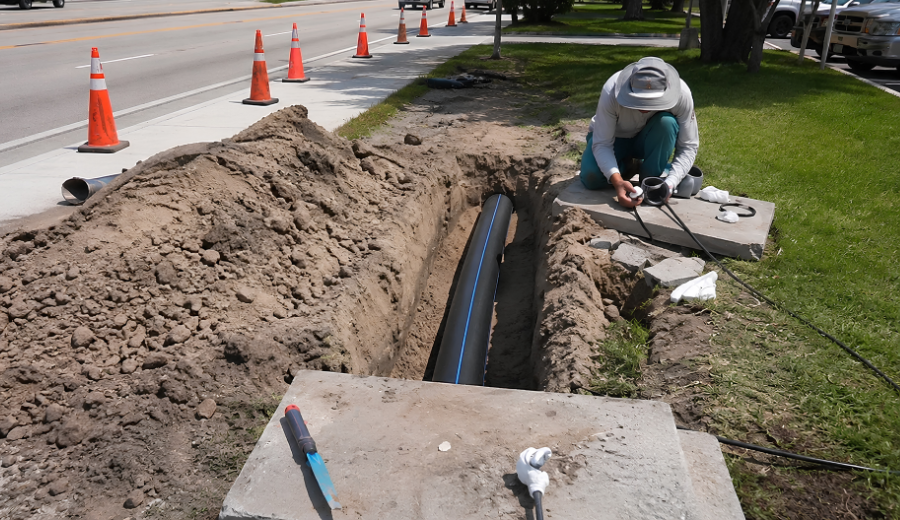
HDPE pipe for water lines is replacing older metal and PVC systems because it doesn’t corrode, its jointing method eliminates common leak points, and it flexes with soil movement instead of cracking under pressure. Municipalities are specifying it for new water main projects, and homeowners are choosing it for replacements because it holds up far longer underground with less maintenance.
If you’ve noticed more contractors recommending polyethylene over traditional pipe materials, you’re seeing a shift that’s been building across the water utility industry for years. This guide covers what’s driving the switch, how the material performs compared to older options, and what it means for a typical residential or municipal water line project. For property owners across South Florida, choosing a contractor with experience in trenchless HDD installation helps ensure a reliable, leak-free water system built for long-term performance.
Why Are Municipalities Switching to HDPE for Water Mains?
Water utilities manage miles of underground pipe, and every leak, break, or corrosion issue translates directly into repair costs and service disruptions. Municipalities have increasingly moved toward polyethylene because it reduces exactly those long-term maintenance headaches.
Here’s what’s driving the shift at the municipal level:
- Corrosion resistance eliminates the internal rust and scaling common in older metal water mains.
- Continuous, jointless runs remove the mechanical connections most prone to failure over decades of service.
- Flexibility allows the pipe to handle ground movement and seismic activity without cracking.
- Lower long-term maintenance costs compared to replacing aging cast iron or steel infrastructure.
Why Are Homeowners Choosing HDPE Pipe for Water Lines?
Homeowners face a similar decision on a smaller scale, usually when replacing an aging line or planning new construction. The same durability that appeals to municipalities is exactly what makes this material a smart choice for residential water service too. Many projects also use trenchless techniques to install water lines underground with minimal disruption, preserving existing landscaping, driveways, and sidewalks while reducing excavation costs.
- Resistant to the corrosion that eventually causes leaks in older copper or galvanized lines.
- Installed through trenchless methods, meaning driveways and landscaping stay intact.
- Continuous pipe runs mean fewer potential points of failure underground.
- Long service life reduces the likelihood of needing another replacement for decades.
How Does HDPE Compare to PVC and Copper for Water Lines?
Choosing a pipe material usually comes down to weighing durability, installation method, and long-term performance against upfront cost. Each material has trade-offs, but the comparison tends to favor polyethylene for underground water service specifically.
- Corrosion resistance: HDPE doesn't rust or corrode, while copper and steel eventually do.
- Joint strength: HDPE's jointing methods are as strong as the pipe itself, unlike glued PVC or soldered copper.
- Flexibility: HDPE bends with ground movement, while PVC and copper are more prone to cracking.
- Installation Method: Compatible with trenchless boring, avoiding the need to fully excavate a trench. In fact, HDPE conduit is the material our crews typically use for directional drilling, in place of PVC
What Makes HDPE Water Line Systems So Reliable?
A water line is only as reliable as its weakest connection, and that’s exactly where older pipe materials tend to fail first. HDPE’s design changes that equation by minimizing the number of separate, weaker components in the system.
- HDPE sections are joined into one continuous, seamless line before installation.
- There are no couplings, gaskets, or fittings left to loosen or corrode over time.
- A properly installed run is rated as strong as the pipe itself.
- Long, uninterrupted runs reduce the number of connection points in the entire system.
Can HDPE Be Installed Without Digging Up the Yard or Street?
One of the biggest practical advantages of this material is how well it pairs with trenchless installation. Because it’s flexible enough to be pulled through a bore path, property owners rarely need to open a full trench to install a water line underground. Homeowners and contractors across Central Florida often choose this approach because it combines a durable, continuous pipe run with efficient trenchless installation for both residential and commercial water line projects.
- Horizontal directional drilling pulls HDPE conduit through a guided underground path.
- Missile boring handles shorter, straight runs beneath driveways and sidewalks.
- Only small access pits are needed at the entry and exit points of the bore.
- Landscaping, concrete, and pavement stay untouched throughout the installation.
Is HDPE Pipe a Good Fit for Florida's Soil and Water Conditions?
Florida presents its own underground challenges, from sandy, shifting soil to high water tables in many areas. This material happens to perform particularly well under exactly those conditions.
- Flexes with the natural movement of sandy soil instead of cracking under stress.
- Resists the corrosion that can be accelerated by Florida's high water tables.
- Handles the pressure demands of both residential and municipal water systems.
- Performs consistently across the coastal and inland soil conditions found statewide.
How Long Does HDPE Last Compared to Older Pipe Materials?
Longevity is one of the clearest reasons this material has gained ground over the past few decades. Municipalities plan infrastructure investments in terms of decades, and this pipe is built to match that timeline.
- Rated for a service life often exceeding 50 years under normal conditions.
- Outlasts many galvanized steel and older PVC systems prone to earlier failure.
- Continuous underground runs don't degrade the way mechanical couplings can over time.
- Reduces the frequency of full system replacements for both homeowners and utilities.
Frequently Asked Questions
Why is HDPE pipe for water lines becoming more common?
It resists corrosion, installs as a continuous, leak-resistant run, and flexes with ground movement, making it more durable than older metal or PVC water lines.
Is HDPE pipe safe for drinking water?
Yes. HDPE pipe rated for potable water use meets the standards required for municipal and residential drinking water systems.
How does HDPE compare to copper for a home water line?
HDPE resists corrosion and installs as a continuous run instead of relying on soldered connections, which typically makes it more durable over the long term than copper.
Can HDPE water lines be installed without trenching the yard?
Yes. Trenchless methods like horizontal directional drilling and missile boring install HDPE pipe through small access pits instead of an open trench.
How long does HDPE pipe typically last underground?
Properly installed HDPE pipe often has a service life exceeding 50 years under normal conditions
Do municipalities use the same HDPE pipe as residential installations?
Yes, though municipal projects typically use larger diameters and pressure ratings suited to water main capacity.
Final Thoughts
The switch to HDPE pipe for water lines isn’t a trend; it’s a response to decades of corrosion issues, joint failures, and repair costs tied to older pipe materials. Whether it’s a municipality planning a new water main or a homeowner replacing an aging line, polyethylene offers a longer-lasting, lower-maintenance solution.
Upgrade to a Durable, Leak-Free HDPE Water Line
Whether you’re replacing an aging water line or installing a new one, Trenchless Drilling, LLC delivers expert trenchless installation with minimal disruption using HDPE conduit across Ocala, West Palm Beach, and Orlando. Our experienced team serves homeowners, contractors, and municipalities across Florida with reliable, long-lasting water line solutions. Contact us today for a free estimate or call (305) 600-1734 to get started.