
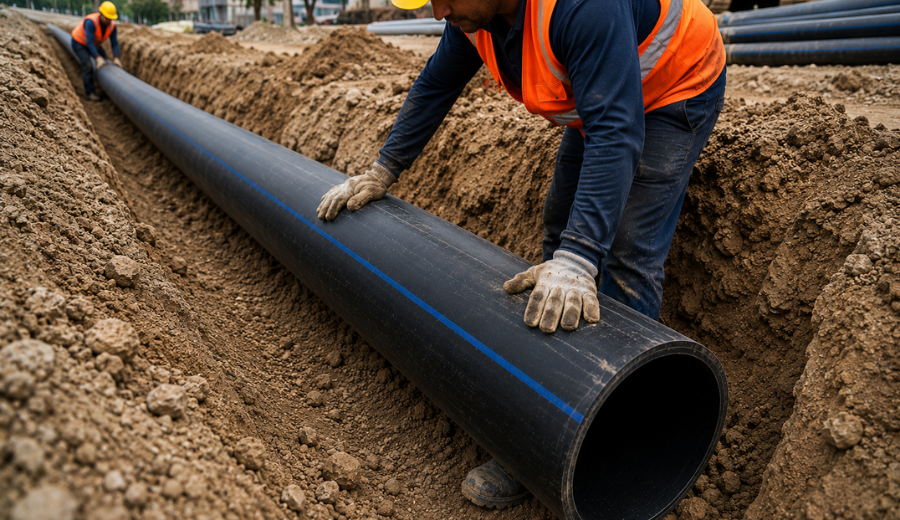
HDPE pipe fusion is the process of joining high-density polyethylene pipe sections into one continuous, leak-free line using heat and pressure instead of couplings or glue. The three main techniques are butt fusion, socket fusion, and electrofusion, and while all three create a permanent bond, butt fusion is the method most commonly used for the long, continuous pipe runs required in horizontal directional drilling.
If a contractor has recommended fused HDPE for your water, sewer, or conduit project, it helps to understand how these three fusion methods actually differ and why one is typically chosen over the others for trenchless installation. This guide explains each technique, how it works, and where it fits. Our team’s hands-on experience with horizontal directional drilling across Florida means we understand exactly how these pipeline systems perform once they’re in the ground.
What Is HDPE Pipe Fusion, and Why Does It Matter?
Rather than relying on a mechanical connection that can loosen or corrode over time, fusion actually melts the pipe material itself so two sections become one solid piece. This is what makes a properly fused joint as strong as, or stronger than, the pipe on either side of it.
Here’s why the process matters:
- Creates a single, seamless pipeline with no couplings, gaskets, or weak points.
- Produces a joint rated as strong as the pipe itself when done correctly.
- Allows long continuous runs to be pulled through a directional drill without separating.
- Reduces long-term maintenance since there are no mechanical fittings to fail.
Method 1: Butt Fusion
Butt fusion is the most widely used HDPE fusion method, especially for trenchless drilling projects that require long, continuous pipe strings. A fusion machine holds two pipe ends in place, heats them with a heater plate, then presses them together under controlled pressure to cool into a permanent bond.
- Best suited for joining straight sections of larger-diameter pipe end-to-end.
- Uses a butt fusion machine to align, heat, and press the pipe sections together.
- Produces the strongest, most reliable joint for long pull lengths in HDD projects.
- Standard method for water, sewer, and conduit runs pulled through a directional bore.
The general butt fusion sequence looks like this:
- Secure both pipe ends in the fusion machine and face them for a clean, flat surface.
- Align the pipe sections precisely before heating begins.
- Heat both ends using a heater plate until the material reaches fusion temperature.
- Press the heated ends together under controlled pressure and hold until the joint cools.
Method 2: Socket Fusion
Socket fusion is typically used for smaller-diameter pipe and fittings rather than long straight runs. Instead of joining two flat pipe ends, the outside of the pipe and the inside of a socket fitting are heated at the same time, then the pipe is inserted directly into the fitting.
- Suited to smaller-diameter pipe connections and fittings rather than long pulls.
- Heats the pipe's outer surface and the fitting's inner surface simultaneously.
- Creates a compact joint useful in tighter spaces where a butt fusion machine won't fit.
- More common in smaller service connections than in long directional drilling runs.
Method 3: Electrofusion
Electrofusion HDPE joints work differently from the other two methods because the heat comes from inside the fitting rather than an external heater plate. A special coupling with an internal heating element is placed around the pipe ends, and an electrical current melts the pipe and fitting together.
- Uses electrofusion couplings with internal heating coils instead of an external heater plate.
- Well suited to repair situations or tight spaces where a fusion machine can't be positioned.
- Commonly used with prefabricated fittings like elbows, tees, and repair couplers.
- Requires specialized equipment to deliver and control the electrical current during the joint.
Butt Fusion vs. Socket Fusion vs. Electrofusion: Which One Fits Your Project?
Each method solves a different joining challenge, which is why contractors don’t default to just one technique for every job. Matching the method to the pipe size, layout, and application is what determines the right choice.
- Butt fusion: Best for long, straight pipe runs and large-diameter lines pulled through HDD.
- Socket fusion: Best for smaller-diameter connections and tighter fitting work.
- Electrofusion: Best for repairs, fittings, and situations where a fusion machine has no room to operate.
For horizontal directional drilling projects specifically, butt fusion remains the standard because it produces the continuous, high-strength pipe string needed to withstand the tension of being pulled through a bore.
What Makes a Fusion Joint Fail If It's Not Done Correctly?
A fused joint is only as reliable as the process behind it, and small errors during preparation or heating can compromise the entire connection. This is why trained technicians and proper equipment matter as much as the fusion method itself.
- Improper facing or misalignment of the pipe ends before heating begins.
- Incorrect heating temperature or timing during the fusion process.
- Contamination on the pipe surface from dirt, moisture, or debris.
- Insufficient pressure or cooling time before the joint is disturbed.
Why Butt Fusion Is the Standard for Trenchless Drilling
Horizontal directional drilling puts significant tensile force on a pipe as it’s pulled through the bore, which is exactly the kind of stress a butt-fused joint is built to handle. This is why it’s the primary fusion method used on most HDD projects. Our experienced crews see the results of this firsthand on every directional bore we run across Florida.
- Produces the strongest, most continuous joint for long pull lengths.
- Withstands the tension and friction of being pulled through an underground bore.
- Eliminates the multiple connection points that smaller fittings would require.
- Delivers a leak-free line for water, sewer, gas, and telecom conduit installations.
Frequently Asked Questions
What is the most common type of HDPE pipe fusion?
Butt fusion is the most common method, especially for long, continuous runs used in horizontal directional drilling.
What's the difference between butt fusion and electrofusion?
Butt fusion uses an external heater plate to join two flat pipe ends, while electrofusion HDPE couplings heat the joint internally using an electrical current.
When is socket fusion used instead of butt fusion?
Socket fusion is typically used for smaller-diameter pipe and fittings, while butt fusion is used for larger pipe and long straight runs.
Why is butt fusion preferred for horizontal directional drilling?
It creates the strongest, most continuous joint, which is necessary to withstand the tension of being pulled through an underground bore.
Can a poorly fused joint fail underground?
Yes. Improper alignment, heating, or contamination during the fusion process can weaken the joint, which is why trained technicians and proper equipment are essential.
Is HDPE pipe fusion used for water and sewer lines?
Yes. Fused HDPE is commonly used for potable water lines, sewer systems, gas distribution, and electrical or telecom conduit.
Final Thoughts
Butt fusion, socket fusion, and electrofusion each solve a different piece of the HDPE puzzle, but for trenchless drilling, butt fusion remains the method built to handle the job. A properly fused joint means a leak-free pipeline that can withstand decades of underground service.
If you have a project in West Palm Beach, Orlando, Ocala, or anywhere else in Florida, Trenchless Drilling, LLC, can fuse and install your HDPE pipeline from start to finish. Request a free estimate or call (305) 600-1734 to get started.
Need Professional HDPE Pipe Fusion for Your Next Project?
Whether your project requires butt fusion, socket fusion, or electrofusion HDPE, our experienced team delivers strong, leak-free pipe joints built for long-term performance. From horizontal directional drilling to water, sewer, gas, and conduit installations, our team brings decades of trenchless expertise to every project across Florida. Contact Trenchless Drilling, LLC today for a free estimate and let our experts handle your project from planning to installation..
Call (305) 600-1734 or request your free estimate today.