
Installing water lines, gas pipes, and electrical cables underground seems straightforward until a contractor digs straight through a driveway or damages a neighbor’s irrigation system. The damage ranges from cracked concrete to destroyed landscaping to broken underground utility lines that cost thousands to repair. The good news? Smart planning prevents almost all of it.
Last month, three homeowners faced unexpected repair bills. One had a foundation crack requiring structural engineering. Another lost an irrigation system worth $8,000. A third discovered a broken gas line that the utility company caught just in time. All three situations were preventable with proper planning.
What Actually Happens During Underground Utility Installation
- Driveways and sidewalks
- Lawns and landscaping
- Foundations
- Irrigation and drainage systems
- Existing utility lines you didn't know about
In Orlando and West Palm Beach, sandy soil makes this worse. Soil shifts and collapses if contractors don’t account for local soil conditions. Unlike clay or compacted earth in northern states, Florida’s sandy composition offers minimal support. Heavy equipment sinks. Trenches cave in. Shallow utility lines shift and break.
Your property bears the cost. Homeowners spend $3,000 to $15,000 fixing preventable damage, often more than the original utility project itself.
Why Most Property Damage Happens
Incorrect utility mapping tops the list. Contractors who skip professional locating services hit existing lines. You get service interruptions, safety hazards, and repair bills that dwarf the original project cost.
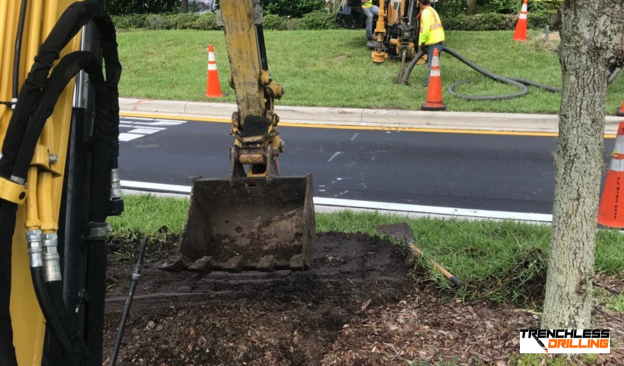
Traditional excavation equipment tears up everything in its path. Heavy machinery compacts soil, destabilizes foundations, and leaves surface damage that requires months of restoration.
How Professional Teams Prevent Damage
Use underground utility locating services first. Before any equipment shows up, professionals map existing lines using specialized technology. Call 811 before you dig, not after. This single step prevents accidents and service interruptions. The process takes one day and costs $150 to $300. Compare that to a $10,000 repair bill when you hit a gas line.
Choose trenchless drilling over traditional digging. Unlike excavation, trenchless methods bore beneath the surface with minimal disruption. Your driveway stays intact. Landscaping stays in place. Restoration costs drop dramatically.
Trenchless drilling works by inserting a small boring head underground. Operators guide it remotely to the target depth and location. No heavy equipment. No open trenches. No surface disruption beyond two small entry/exit points.
Follow controlled excavation practices. Professional crews use precision equipment, limit work zones, and monitor soil stability throughout the project. Property protection stays the priority, not speed.
When traditional excavation is necessary, hand-digging in sensitive areas protects foundations and structures. Yes, it takes longer. But foundations stay intact, and properties look normal when work is complete.
Trenchless Drilling vs. Traditional Excavation
| Method | Surface Damage | Cost | Safety |
| Traditional Excavation | High | Medium | Moderate |
| Trenchless Drilling | Low | High upfront, saves money long-term | High |
What to Look for in a Contractor
Not all contractors understand property protection. Find a concrete scanning Orlando who:
- Has years of trenchless drilling experience (at least 5-10 years in your area)
- Carries proper licensing and insurance (verify with your state and county)
- Understands Florida's unique soil conditions and code requirements
- Uses modern locating technology before digging
- Can explain their process and answer your questions without rushing you
Ask for references from recent projects. Contact those homeowners. Ask them if their property looked good afterward. Ask if the contractor communicated well and stayed on schedule.
Check their equipment. A contractor with older digging machinery will push you toward traditional excavation. A contractor with modern trenchless rigs can offer real options. Equipment investment signals they’re serious about property protection.
Most importantly, trust your gut. A good contractor won’t pressure you into a decision. They’ll walk your property, answer concerns, and explain multiple approaches.
Your Pre-Installation Checklist
- Request a utility mapping report (required, not optional)
- Confirm use of trenchless or low-impact methods in writing
- Walk the site with the contractor to identify risks
- Verify licensing and insurance certificates
- Get restoration plans in writing
- Discuss timeline and who handles cleanup
This takes an hour. Skipping it costs thousands.
Frequently Asked Questions
How deep do utility lines go?
Can improper installation damage my foundation?
Does trenchless cost more?
Initial costs run higher, but you save money by avoiding property repairs and restoration work.
Do I really need locating services?
How long does the project take?
Conclusion
Protect Your Property the Right Way
Underground utility installation doesn’t require property damage. Smart contractors use advanced locating services, trenchless technology, and controlled excavation practices. Choosing the right trenchless or excavation company Orlando from the start protects your property and avoids thousands in repairs down the road.
Ready to protect your property during utility installation? Contact Trenchless Drilling, LLC today for a free site evaluation and cost comparison. We’ll show you how trenchless drilling protects what matters most.