
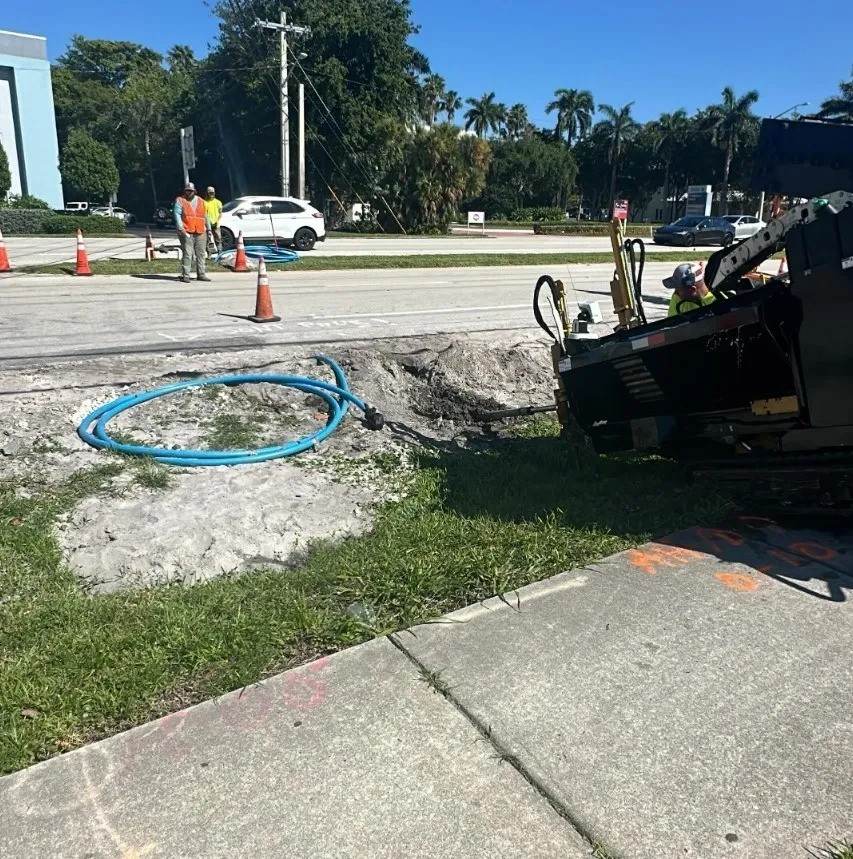
In the realm of modern infrastructure development, the need for efficient and minimally invasive techniques is paramount. Horizontal Directional Drilling (HDD) has emerged as a revolutionary method for installing utilities such as water pipelines with minimal disruption to the environment and existing structures. This blog explores the intricacies of HDD technology and its application in water service installation.
Understanding HDD Technology: HDD is a trenchless method used to install underground pipelines, conduits, and cables along a prescribed bore path. Unlike traditional open-cut methods, HDD eliminates the need for extensive excavation, reducing environmental impact and disturbance to communities. The process involves three main components: drilling equipment, drill string, and a tracking system.
The drilling equipment, typically consisting of a drill rig, generates the necessary force to propel a drill string through the subsurface. The drill string, composed of drill rods and a drill bit, creates a pilot bore along the desired path. Throughout the drilling process, a tracking system, often utilizing electromagnetic or gyroscopic technology, provides real-time data on the location and orientation of the drill head.
Case Study: Water Pipeline Installation Using HDD Let’s consider a hypothetical scenario where a municipality intends to install a water pipeline beneath a densely populated urban area. Traditional excavation methods would require extensive road closures, rerouting of traffic, and disruption to businesses and residents. Alternatively, employing HDD technology offers a more efficient and less intrusive solution.
The HDD process begins with a comprehensive site assessment to identify potential obstacles and determine the optimal bore path. Once the bore path is established, the drill rig is positioned at the designated entry point, typically located outside the urban area to minimize disruption.
Using advanced tracking systems, the drill operator navigates the drill head along the predetermined path, avoiding underground utilities, infrastructure, and sensitive environmental areas. As the pilot bore progresses, the drill string is gradually enlarged to accommodate the water pipeline.
Upon reaching the exit point, the drill string is retrieved, and the pipeline is installed within the pre-reamed borehole. Finally, connections are made to existing water infrastructure, and the site is restored to its original condition.
Conclusion: Horizontal Directional Drilling (HDD) technology represents a paradigm shift in water service installation, offering a versatile, environmentally conscious, and cost-effective alternative to traditional excavation methods. By harnessing the power of HDD, municipalities and utility providers can overcome the challenges of urban development while minimizing disruption and maximizing efficiency. As we continue to advance in infrastructure development, embracing innovative techniques like HDD will be instrumental in building sustainable and resilient communities for the future.