
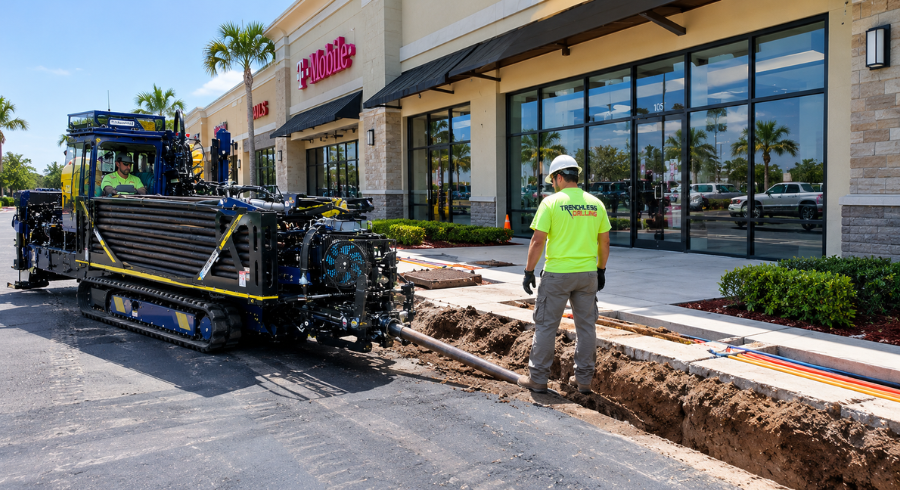
A retail center electrical upgrade doesn’t have to mean closing the parking lot or shutting down a single tenant. The method is directional boring: new feeders and conduit are run under the lot, from the electrical room to wherever the power is needed, with no open trenching across the surface.
Shopfronts stay open, parking stays available, and the work finishes with the pavement intact.
This guide explains why retail centers need these upgrades, why the underground run is the disruptive part, and how a no-dig retail center electrical upgrade keeps tenants operating from start to finish.
It is written for property managers, owners, and the general contractors who serve them.
Planning a power upgrade for your retail center? Get a free, no-dig estimate.
Contact Trenchless Drilling for a free estimate | Call (305) 600-1734.
Why Do Retail Centers Need Underground Electrical Upgrades?
Older retail centers were wired for the tenants they opened with. Over the years, the electrical load grows, and the original service starts to fall short.
- New tenants, such as restaurants, gyms, or medical suites, need more power.
- LED lighting upgrades or new circuits for parking lot lights and signs.
- EV charging stations for customers and staff.
- An electrical panel or service that can no longer handle the building’s power needs.
Each of these adds underground work, and most of it has to cross the parking lot to reach the panel. That crossing is where the disruption usually starts.
Signs Your Retail Center Is Due for an Upgrade
Most owners wait until something trips before they look at the electrical. A few signs point to a service that has outgrown the center.
- Breakers trip when several tenants use their equipment at the same time.
- A new tenant needs more power than the existing electrical panel can handle.
- You are installing EV chargers, adding a new pad, or upgrading the lighting.
- The electrical panel or service is old and close to its maximum capacity.
If any of these sound familiar, the fix almost always involves new underground feeders, and that run is far cleaner with a bore than a trench.
Why Is the Underground Run the Disruptive Part?
The main electrical panel is often located in one area, but the new equipment or circuits may be needed across the property.
Connecting the two means running conduit across finished pavement. Many property managers start by calling a trenching and excavation company in Tampa, and open-cut work is usually what they get quoted. It saws the lot, closes rows of spaces, and blocks the shopfronts the trench passes. For a center that runs on foot traffic, that is lost business for every nearby tenant.
It can also mean dust, barriers, and a patched section of asphalt that stands out from the rest of the lot. Property owners may end up paying twice: once for the electrical work and again to repair the pavement.
The electrical upgrade is usually straightforward. It’s the thought of digging up the parking lot that worries property owners.
How Do You Upgrade Without Disrupting Tenants?
Directional boring installs the new conduit underground without cutting through the parking lot. A compact drilling machine creates a path beneath the pavement, then pulls the electrical conduit through it. This usually requires only two small access pits, one at each end.
- Parking remains open because there is no need to cut through the pavement.
- Storefronts stay accessible because no trench runs across the walkways.
- The existing power can often stay on while the new line is installed, depending on the work involved.
- Most projects take one or two days, with work scheduled around tenant hours when possible.
The result is a finished upgrade with pavement that looks untouched and tenants who kept trading the whole time. For a leased property, that continuity protects both the rent roll and the owner’s reputation with the tenants.
What a No-Dig Retail Electrical Upgrade Covers
The same no-dig method handles most of the electrical work a retail center needs. Here is what a bored upgrade covers and how little it touches tenants.
| Upgrade | What gets bored under the lot | Tenant impact |
|---|---|---|
| Service / panel capacity upgrade | New feeders from the meter or transformer to the main panel | Minimal; power stays live during the bore. |
| New feeder to a tenant unit or pad | Conduit from the panel to the new space | None for other tenants |
| Parking lot LED lighting | Circuits to light poles and bases | The lot stays open; work can run after hours. |
| EV charging readiness | Conduit from the panel to charger locations | None; spaces stay usable until tie-in. |
| Sign or pylon power | A line to the sign base across the lot | None; no shopfront blocked. |
Want more power without closing the lot? We bore the feeders clean.
Contact Trenchless Drilling for a free estimate | Call (305) 600-1734.
Conduit and Access Points for Retail Feeders
For the bored run, HDPE conduit is the standard. It is flexible, pulls cleanly through a long bore, and resists corrosion in Florida ground, which is why it is our default pipe for directional drilling. Careful underground conduit installation seals the ends so soil and water stay out.
Longer feeder runs and multi-tenant centers use handholes and pull boxes along the path. These underground access points let an electrician pull, splice, or add cable later without a fresh bore, which saves money on every future change.
Size the conduit with room to spare. A center that adds a tenant or an EV bank in two years will thank you for the extra capacity left in the ground. Spare conduit laid during the first bore turns a future upgrade into a simple cable pull instead of a second project.
Planning the Upgrade Around Tenants
Timing is half the job at a retail center. A good crew plans the bore path, the access pits, and the tie-in around the center’s busiest hours.
Short crossings under a single row can use pneumatic missile boring in minutes. The access pits sit in low-traffic corners, and the final tie-in is scheduled for a slow window or after close, so tenants often do not notice the work at all.
The same approach handles powering parking lot lighting and other circuits across the property, so several upgrades can share one mobilization and one round of permits.
What Drives the Cost and Timeline?
No two retail centers price the same, but the main factors are easy to name. A clear quote rests on a handful of details.
- The distance between the electrical room and the area that needs power.
- The size of the conduit and the number of feeders required.
- Whether the existing electrical panel or service needs an upgrade.
- The cost of permits, inspections, and coordination with the utility company.
Because boring skips the asphalt cutting and resurfacing a trench requires, the total usually lands lower than open-cut once the restoration bill is counted. Several upgrades booked together also share one setup, which trims the cost of each.
Why Property Managers Choose a Licensed Trenchless Crew
A retail center is a working property with many tenants depending on it. Trenchless Drilling is a licensed Florida general contractor (CGC1526763) with more than 20 years of trenchless work and over a million linear feet of conduit installed.
Whether you need underground utility installation in Sanford or anywhere else across Central Florida, we run the feeders under the lot, keep the power live, and leave the pavement intact.
Frequently Asked Questions
Can a retail center upgrade its electrical without closing the parking lot?
Yes. Directional boring runs new feeders and conduit under the lot, so the surface is never cut and parking stays open. Only two small access pits are needed.
Will tenants lose power during the upgrade?
Not usually. The new line is bored and pulled while the existing power stays live, and the final tie-in is scheduled for a short, planned window, often after hours.
How long does a retail electrical upgrade take?
The underground bore for a typical feeder is often done in a day or two. Panel work and utility coordination can add time and are planned around tenant hours, so the busiest trading days stay clear of heavy work.
What conduit is used for retail center feeders?
HDPE conduit is the standard for the bored run. It is durable, corrosion-resistant, and pulls cleanly through a long bore. Handholes are added along the way for future access.
Does underground electrical work at a retail center need a permit?
Yes. Most feeder and service upgrades need a permit and inspection. A licensed contractor pulls the permit, files the 811 locate, and coordinates with the local utility before any work starts so the upgrade passes inspection the first time.
Ready to add power without the downtime? Trenchless drilling upgrades retail center electrical underground, with tenants open and the lot intact, across Florida.
Get your free retail center electrical upgrade estimate today.