
Electrical problems in a shopping plaza parking lot are rarely convenient.
A failed light, damaged underground conduit, exposed wiring, or a problem with a sign circuit can quickly become a bigger issue when customers still need access to the property, and tenants need to stay open.
That raises an important question for property managers:
Can you complete shopping plaza parking lot electrical repairs without closing the entire parking lot?
Often, yes. The key is planning the work around the property’s existing traffic, underground utilities, electrical layout, and business hours.
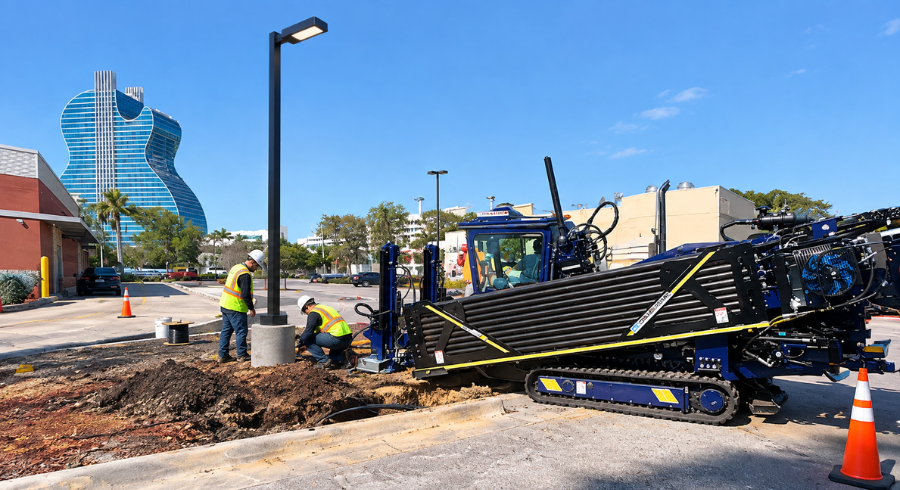
For many repairs and underground installations, trenchless methods such as horizontal directional drilling (HDD) can reduce surface disruption compared with traditional open excavation.
What Counts as Shopping Plaza Parking Lot Electrical Work?
Parking-lot electrical systems include more than the light fixtures you see overhead.
Depending on the property, the system may include:
- Parking lot lighting circuits
- Underground electrical conduit
- Light poles and fixture connections
- Handholes and pull boxes
- Signage power
- Pylon sign electrical systems
- Pedestrian and perimeter lighting
- Security lighting
- Electrical service connections
- Controls, timers, and photocells
A problem in one part of the system can sometimes affect several fixtures or circuits.
For example, if multiple lights along one section of a shopping plaza stop working, replacing the bulbs may not solve the problem. The issue could involve a circuit, underground wiring, damaged conduit, or a connection point.
The first step is finding the actual cause instead of treating every outage as a fixture problem.
Can You Repair Parking Lot Electrical Systems Without Closing the Lot?
In many cases, yes, but the repair method and site conditions determine how much disruption is necessary.
A contractor may be able to work in phases, use isolated work areas, schedule certain tasks during lower-traffic periods, or use trenchless installation methods where underground conduit needs to cross pavement.
The goal isn’t to promise that every project can happen without restricting any parking spaces.
The goal is to minimize the area and duration of disruption while keeping the shopping plaza functional.
That distinction matters.
A busy retail property may have restaurants, grocery stores, pharmacies, offices, and other tenants operating at different hours. Closing the entire lot for an underground repair may create unnecessary problems.
Start With a Site Assessment
Before deciding how to repair the electrical system, identify what is actually underground.
Review:
- Existing electrical drawings or as-built plans
- Conduit routes
- Handholes and pull boxes
- Existing utility locations
- Pole and fixture locations
- Signage circuits
- Proposed repair locations
- Areas with heavy customer traffic
- Access points for drilling or excavation
If existing drawings aren’t available or the underground layout is uncertain, utility locating or concrete scanning may be appropriate before construction begins.
This is especially important when drilling, cutting, coring, or excavating near existing utilities.
Why Concrete Scanning Matters
When work involves concrete slabs, sidewalks, foundations, or other reinforced areas, concrete scanning Jacksonville services can help identify subsurface conditions before cutting or drilling.
The broader principle is simple:
Know what’s below the surface before you disturb it.
For underground utility work, ground-penetrating radar and other locating methods can also help identify existing utilities and plan a safer bore path.
When Is Trenchless Installation a Better Option?
Suppose a shopping plaza needs new electrical conduit from one side of the property to another, but the proposed route crosses an active parking area.
Traditional excavation may require cutting the pavement, creating an open trench, restricting traffic, and restoring the surface afterward.
HDD approaches the problem differently.
A directional drill creates a controlled underground path, allowing conduit to be installed beneath the surface without opening the entire route.
This can be particularly useful for:
- New parking-lot lighting circuits
- Replacement conduit
- Pylon sign power
- EV charging infrastructure
- Security systems
- Communication lines
- Electrical service extensions
Trenchless Drilling, LLC’s published project portfolio includes commercial conduit installations beneath active parking lots, including a 320-linear-foot electrical conduit project in Miramar and a 410-linear-foot FPL conduit installation beneath an active parking lot. Its completed-project portfolio also documents approximately 110 feet of boring beneath a Walmart parking lot for lighting power.
Need Underground Electrical Work in Jacksonville?
If your repair or upgrade requires new conduit beneath an active parking area, underground electrical conduit installation in Jacksonville can be a practical option to evaluate before choosing open excavation.
How to Repair Electrical Systems Without Disrupting Every Tenant
A shopping plaza repair should be planned around operations, not just construction.
Work in phases
Instead of closing the entire parking lot, isolate the area where work is taking place whenever site conditions allow.
Schedule strategically
Some work can be planned during slower traffic periods or outside peak business hours.
Keep pedestrian routes open
Customers still need safe paths between parking spaces, sidewalks, and storefronts.
Protect access for emergency services
Work zones should never interfere with required emergency access.
Coordinate with tenants
Property managers should communicate planned restrictions to affected businesses before work begins.
Choose the least disruptive installation method
If the repair requires underground conduit across pavement, compare trenchless installation with open excavation before construction starts.
The best approach is often the one that solves the electrical problem without creating a second operational problem.
What About Strip Mall Parking Lot Lighting?
Lighting is one of the most visible parts of a retail property’s electrical infrastructure.
A failed fixture may be a simple repair. But recurring outages, dark areas, damaged wiring, or aging underground infrastructure can indicate a larger issue.
A strip mall parking lot lighting system should be evaluated as a complete system rather than as a collection of individual light fixtures.
Look at:
- Fixture condition
- Pole condition
- Circuit performance
- Underground conduit
- Wiring
- Controls
- Light distribution
- Areas of repeated failure
If the same section of a parking lot repeatedly loses lighting, investigate what connects those fixtures before repeatedly replacing individual components.
Don't Forget Pylon Sign Electrical Systems
Shopping plazas often depend on large pylon signs to identify the property and its tenants from the road.
When a sign goes dark, the problem may involve the sign itself, the electrical connection, underground conduit, or the circuit supplying the sign.
A pylon sign electrical installation or repair may therefore require underground work between the sign and the property’s electrical source.
If that route crosses a parking lot, sidewalk, or landscaped area, trenchless installation may help reduce the amount of surface excavation required when conditions are suitable.
Open Excavation vs. HDD for a Shopping Plaza
Neither method is right for every project.
| Consideration | Open-Cut Excavation | HDD |
|---|---|---|
|
Pavement removal
|
Often required
|
Usually minimized |
|
Parking disruption |
Can be greater |
Often reduced |
|
Utility locating
|
Required |
Required |
|
Surface restoration |
May be significant
|
Typically reduced
|
|
Open areas |
Often practical |
May not be necessary
|
|
Paved crossings |
Can be disruptive |
Often worth evaluating |
HDD isn’t a shortcut around planning. Existing utilities still need to be located, the bore path needs to be planned, and soil and site conditions need to be considered.
The right method depends on the project.
Common Mistakes Property Managers Should Avoid
Waiting until a small outage becomes a major repair
Repeated electrical failures can be a sign that the underlying infrastructure needs attention.
Assuming every problem is a light fixture
The actual problem may be underground wiring, conduit, a circuit, or a connection.
Digging before locating utilities
Unplanned excavation can create avoidable risks and additional costs.
Closing more parking than necessary
A repair plan should consider whether the work can be phased or completed with a less disruptive installation method.
Ignoring future needs
If you’re already installing new conduit, consider whether the property may need additional electrical capacity, lighting, signage, security, or other underground services later.
A Practical Shopping Plaza Electrical Repair Checklist
Before work begins, ask:
- What exactly has failed?
- Is the problem above ground or underground?
- Where does the existing conduit run?
- Are other utilities nearby?
- Does the work cross active parking areas?
- Can the repair be phased?
- Would HDD reduce surface disruption?
- Do concrete areas need scanning before cutting or drilling?
- How will customers reach affected tenants?
- What work can be completed during lower-traffic hours?
- Does the property need additional conduit for future upgrades?
This checklist can help property managers move from “We have an electrical problem” to “We know what needs to be repaired and how to do it with minimal disruption.”
Shopping Plaza Parking Lot Electrical Repairs FAQ
Can electrical repairs be completed while a shopping plaza remains open?
Often, yes. Depending on the repair, work can be phased, isolated, scheduled around traffic, or completed using trenchless methods. Site conditions determine the appropriate approach.
Can electrical conduit be installed under an active parking lot?
Yes. HDD can install conduit beneath parking lots without opening a continuous trench across the paved surface when conditions are suitable.
Should utilities be located before drilling?
Yes. Existing underground utilities should be identified before drilling or excavation. Ground-penetrating radar and other locating methods can help establish what is beneath the proposed work area.
Does every parking lot electrical problem require new conduit?
No. Some problems involve fixtures, controls, connections, or other components. An inspection can help determine whether underground infrastructure actually needs repair or replacement.
How can I minimize disruption to shopping plaza tenants?
Start with a site-specific plan. Identify the work area, coordinate with tenants, maintain safe access, schedule strategically, and evaluate trenchless installation when underground work crosses paved or high-traffic areas.
Conclusion
Shopping plaza electrical repairs don’t have to automatically mean shutting down the entire property.
The right strategy starts with understanding the problem, locating existing infrastructure, coordinating the work around tenant operations, and choosing an installation method that fits the site.
When new or replacement conduit needs to cross an active parking lot, HDD can be an option worth evaluating because it can reduce the need for continuous surface excavation.
Trenchless Drilling, LLC provides underground conduit installation, HDD, utility locating, and related trenchless services for commercial properties in Jacksonville and throughout Florida.
Tell the team where the electrical problem is, what needs to be repaired or added, and what parts of the shopping plaza need to remain accessible. From there, the right installation approach can be evaluated for your property.